Contents
1. Why Tea and Meditation Belong Together
2. The Chemistry of Calm: What Tea Actually Does to the Brain
3. The Cup as Anchor: Solitude, Weight, and Physical Presence
4. How to Begin: A Step-by-Step Practice
5. The Grand Design of Solitude: Drinking Alone as a Complete Practice
6. The Object You Choose Matters
There is a version of meditation that asks you to sit in silence and think of nothing. For many people, this is the version that does not work — not because they lack discipline, but because the instruction itself offers no foothold. The mind, when told to be empty, typically produces the opposite.
Tea meditation offers a foothold. It is mindful tea drinking in the most practical sense: a practice that uses the specific, concrete actions of preparing and drinking tea — the warmth in the hands, the movement of steam, the successive sensory events of smell and taste — as anchors for attention. You do not have to think of nothing. You have to think of this: this temperature, this colour, this cup, this breath, this sip. The practice is real, it is accessible, and it has measurable physiological effects that support the psychological ones. This guide is for people who have never tried it before.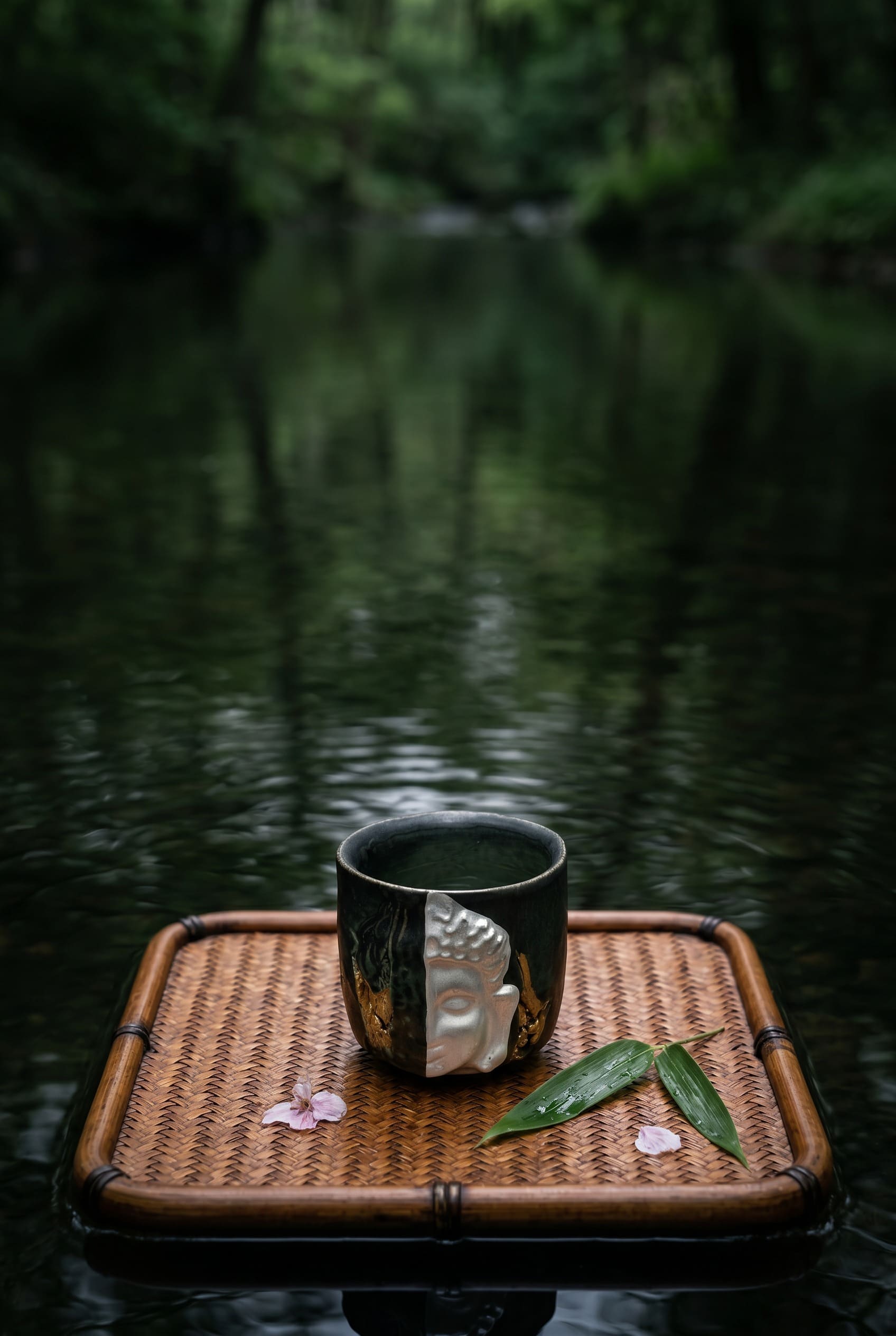
A serene morning tea ritual with a Buddha - adorned teacup on a woven tray by the water, embodying mindful tea drinking and grand design solitude for inner peace.
1. Why Tea and Meditation Belong Together
The relationship between tea and contemplative practice is not metaphorical. It is historical, functional, and — as neuroscience has since confirmed — biochemical. The Japanese tea ceremony (chado, the Way of Tea) developed as a formal contemplative discipline in which the preparation and drinking of tea was itself a complete meditation practice. The Chinese tradition of gongfu cha (功夫茶) similarly treats the preparation of tea as a practice requiring full attention, patience, and presence: the multiple short infusions, the specific temperatures, the observation of colour and fragrance across successive pours. These traditions were not using tea as a vehicle for relaxation in the modern sense. They were using it as a structure for sustained attention — exactly what tea meditation is in its contemporary form.
What these traditions understood intuitively, modern research has confirmed physiologically. Tea provides a uniquely suited biochemical environment for the contemplative state — not because it is sedating, but because its primary active compound, the amino acid L-theanine, produces what researchers describe as a state of calm alertness: reduced anxiety without drowsiness, improved focus without overstimulation. This is the physiological correlate of what meditators are trying to cultivate through practice. Mindful tea drinking is therefore not a soft metaphor for relaxation. It is a practice in which the beverage and the intention reinforce each other at a neurochemical level.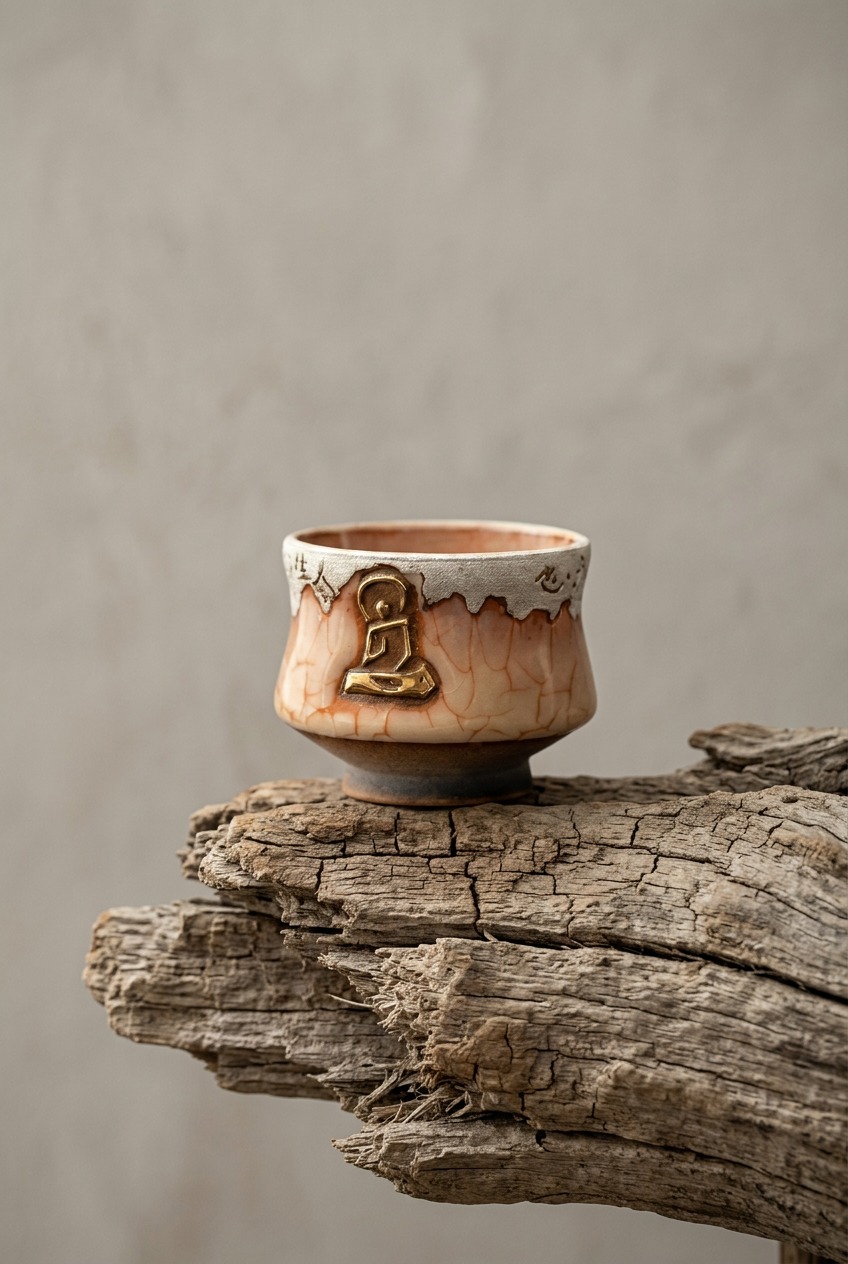
As our guide to tea rituals and their role in contemplative practice explores, the value of a tea ritual is not in the specific tea or the specific cup but in the quality of attention it creates. The ritual provides a sequence of actions that the mind can follow, reducing distraction without forcing stillness. For people who find traditional seated meditation difficult — sitting in silence, watching the breath — tea meditation offers the same quality of presence through a more concrete and forgiving structure.
2. The Chemistry of Calm: What Tea Actually Does to the Brain
Understanding the chemistry of tea is useful for practitioners of tea meditation because it explains why the practice works as well as it does — and why tea for anxiety relief is not simply a folk claim but a physiologically grounded one.
Research published in Nature describes L-theanine's effect on the brain as improving the signal-to-noise ratio — not by increasing the signal, but by decreasing noise. The compound acts on the hypothalamic-pituitary-adrenal (HPA) axis, the body's primary stress-response system, reducing cortisol levels and promoting the production of GABA — the brain's main inhibitory neurotransmitter, which reduces anxiety. A review published in ScienceDirect confirms that L-theanine, as a structural analogue of glutamate, competes for excitatory receptors in the brain and crosses the blood-brain barrier to exert its relaxation effect directly on neural tissue.
ZRT Laboratory's analysis of L-theanine and alpha wave activity explains the mechanism in terms of brain states: L-theanine induces alpha wave oscillation — the brain wave pattern associated with wakeful relaxation, composure, and improved concentration without the edge of anxiety. This is the same brain state that experienced meditators cultivate through practice. A double-blind, placebo-controlled study published in MDPI Nutrients found that participants who consumed L-theanine showed significantly reduced subjective stress responses one hour after ingestion, with salivary cortisol levels also measurably reduced three hours post-dose. A systematic review published in PubMed concluded that 200-400mg of L-theanine per day may assist in the reduction of stress and anxiety in people exposed to stressful conditions.
The practical implication for mindful tea drinking is significant: by the time you finish preparing your cup and sit down to drink it, the biochemical conditions for a meditative state are already being established.
What's happening, biochemically, while you drink:
| What happens | Effect |
|---|---|
| L-theanine crosses the blood-brain barrier | Competes with excitatory receptors, direct calming effect |
| Cortisol levels decrease | Measurable within 1-3 hours of ingestion |
| GABA production increases | Reduces anxiety |
| Brain shifts toward alpha wave activity | The state of "calm alertness" meditators cultivate |
The L-theanine in the tea is beginning to shift your brain's activity toward the alpha wave pattern associated with calm alertness. Your practice and your beverage are working in the same direction simultaneously.
3. The Cup as Anchor: Solitude, Weight, and Physical Presence
Every meditation practice requires an anchor — something specific enough to return attention to when the mind wanders. The breath is the most common anchor in traditional mindfulness practice. In tea meditation, the cup is the anchor. Its warmth against the palms, its weight in the hands, the specific texture of its surface — these provide a continuous stream of sensory input that attention can return to throughout the practice.
This is why the physical character of the cup is not incidental to how to practice mindful drinking. Research on grounding techniques published by Positive Psychology identifies deliberate tactile engagement — concentrating on the specific weight, temperature, and texture of an object held in the hand — as one of the most reliable methods for returning attention to the present moment and interrupting anxiety cycles. A cup with genuine physical presence — with the density of mineral-rich clay, a surface that registers differently at different points of contact, warmth that transfers slowly and evenly from the tea inside — provides a richer and more sustained tactile anchor than a thin, smooth, mass-produced mug. As our exploration of self-care objects and tactile presence explains, weighted objects for anxiety work precisely because their physical presence gives the nervous system something real and immediate to register — pulling attention away from abstract worry and into direct sensory experience.
The solitude dimension of mindful tea drinking is equally important and often undervalued. Drinking alone — without the ambient pressure of conversation, without the need to perform enjoyment or share attention — creates the specific conditions for inward attention that tea meditation requires. This is not loneliness. It is the grand design solitude that contemplative traditions have always understood as a precondition for genuine stillness: the specific quality of being alone not because others are absent, but because one has chosen presence with oneself over the noise of company.
4. How to Begin: A Step-by-Step Practice
The practice in four steps:
| Step | What to do | What it does |
|---|---|---|
| Prepare with attention | Choose your tea consciously, notice the water heating | The practice begins before the first sip |
| Hold before drinking | Hold the cup in both hands, three slow breaths | Activates the parasympathetic nervous system |
| Drink with attention | Notice temperature, flavour, aftertaste — let the mind wander and return | The wandering and returning is the practice itself |
| Finish without rushing | Sit for 30-60 seconds after the cup is empty | Makes the transition back to the day gradual |
The following practice is designed for complete beginners — people who have never attempted tea meditation or formal mindfulness, and who want a structured starting point. It requires nothing except a cup of tea, approximately fifteen minutes, and the willingness to stay with what is happening rather than thinking about what comes next.
Before you begin: space and time
Choose a time when you will not be interrupted — ideally the same time each day, since consistency is what converts a single practice into a morning tea ritual with genuine anchoring power. Early morning, before any device or demand has claimed your attention, is when most practitioners find the practice most effective. As our guide to creating a minimalist meditation corner explores, you do not need a dedicated room — a cleared surface, a cushion, five square feet of floor, and the intention to be present are sufficient. Put your phone in another room or turn it face down. The practice requires only that you are not available to interruption for fifteen minutes.
Step 1: Prepare the tea with full attention
Begin heating water. As you wait, notice the sound of the water as it heats — the shift from silence to the first movement of convection, the change in sound as it approaches temperature. Choose your tea with attention: what do you want from this practice today? Clarity and focus (green tea or light oolong)? Grounding and depth (roasted oolong, pu-erh, black tea)? Warmth without stimulation (herbal infusion)? The choice is not arbitrary — different teas support different qualities of attention, and making the choice consciously is the first act of the practice.
Pour the water at the right temperature for your tea — not boiling for delicate greens and light oolongs (85-90°C), closer to boiling for roasted teas and pu-erh. As you pour, observe the water moving. Watch the colour change as the tea steeps. Smell the steam. These are not decorative attentions — they are the practice beginning.
Step 2: Hold the cup before drinking
When the tea has steeped and you have poured it into your cup, do not drink immediately. Hold the cup in both hands. Feel its weight — the specific density of the material, the way the heat transfers through the walls. If your cup is made from dense clay, you will feel this differently than if it were glass or thin porcelain. Notice the texture under your fingers. Notice the warmth moving into your palms. Take three slow breaths, each one accompanied by the awareness of what your hands are holding.
This pause is doing something physiologically: the warmth against the palms activates thermoreceptors that signal safety to the nervous system, the slow breath activates the parasympathetic nervous system's rest-and-digest response, and the deliberate tactile attention shifts brain activity toward the present-moment sensory experience rather than abstract thought. The practice has already begun.
Step 3: Drink with full attention
Bring the cup to your lips. Notice the temperature of the rim, the smell of the steam at close range. Take the first sip slowly, holding it briefly in the mouth before swallowing. Notice the specific flavour — not "this tastes like tea" but the specific qualities: where is the sweetness? Where is the astringency? How does the flavour change between the first moment of contact and the swallow? How does the aftertaste differ from the taste?
Between sips, return the cup to your hands. Notice when the mind wanders — to the day ahead, to something unresolved, to the phone in the other room. This wandering is not failure. It is the practice: the moment of noticing the wandering is the moment of return, and every return is a repetition of the core skill being trained. How to practice mindful drinking is, at its most fundamental level, the practice of noticing where attention went, and bringing it back to the cup.
Step 4: Finish without rushing
Drink the full cup at this pace — present for each sip, returning each time the mind wanders. When the cup is empty, hold it for a moment. Notice the absence of heat where there was warmth. Set it down deliberately. Sit for thirty seconds to one minute without immediately reaching for the phone or standing up. Let the transition back to ordinary activity be gradual rather than abrupt.
This is the complete practice for a beginner. Fifteen minutes, one cup, full attention. The morning tea ritual consistency — returning to it each morning at the same time, with the same cup — is what converts this from an occasional exercise into a genuine practice anchor.
5. The Grand Design of Solitude: Drinking Alone as a Complete Practice
Grand design solitude is a phrase from the contemplative tradition that describes a specific kind of aloneness: not the aloneness of isolation or loneliness, but the deliberate choice to be with oneself — without the mediating presence of other people, devices, or ambient noise — in a way that allows genuine self-encounter. This is the tradition behind the Japanese tea ceremony as a solo practice, behind the Chinese literati's habit of drinking tea alone in their studios as a form of qingxiu (清修) — quiet cultivation — and behind the contemporary practice of mindful tea drinking as a daily ritual.
The research on solitude and wellbeing supports what practitioners have always known. Psychologists distinguish between unwanted loneliness — a state of painful social isolation — and chosen solitude, which is associated with creativity, self-understanding, emotional regulation, and psychological restoration. Chosen solitude provides access to internal states that social presence typically crowds out: the specific texture of one's own attention, the particular quality of the morning before the world has made its claims, the experience of being present with oneself rather than performing presence for others.
How to find inner peace is one of the most searched questions in the contemplative space, and most of the answers involve some form of regular, deliberate solitude. Tea meditation is one of the most accessible structures for this: it requires minimal time (fifteen minutes), no equipment beyond a cup and a kettle, no instruction beyond the willingness to stay present, and no particular belief system or prior practice. It is available every morning, regardless of whether you slept well or feel calm or think you are 'ready' to meditate. The cup is always there. The practice begins with boiling water.
For people who find the idea of grand design solitude uncomfortable — for whom being alone with their thoughts feels more like confrontation than cultivation — tea for anxiety relief offers a gentler entry point. The specific sensory structure of the practice gives the mind something to do that is not thinking about itself. The warmth of the cup, the sequence of steeping and pouring, the successive flavours of a multi-infusion tea: these are enough to occupy the anxious mind's need for a task while simultaneously drawing it toward stillness. The how to find inner peace question, approached through tea, does not require sitting with nothing. It requires sitting with this cup, this warmth, this breath.
6. The Object You Choose Matters
The cup you use for tea meditation is part of the practice, not separate from it. This is not aestheticism — it is function. A cup that has genuine tactile presence, that registers as specific and real in the hands, provides a more effective anchor for attention than one that is thin, uniform, and physically unremarkable. The practice relies on sensory input to hold the mind present. More sensory input — more surface variation, more weight, more warmth transfer — means a more richly anchored practice.
A handmade cup from mineral-rich clay has specific qualities that serve this function well: the density of a high-fired clay body transfers heat slowly and evenly, keeping the tea warmer for longer and providing a sustained thermal anchor rather than one that fades quickly. The surface texture — the mineral particles that did not melt at firing temperature, creating the characteristic coarse-grained feel of rock-mineral clay — provides continuous tactile variation as the hands move across it. As our guide to the art of caring for a tea cup and patina development explains, a cup used consistently for a morning tea ritual develops a patina over time — the tea compounds accumulating in the porous clay surface, the hands' oils absorbed into the exterior — that makes the cup progressively more specific to its owner. This is the weighted objects for anxiety principle made concrete across time: an object that becomes more anchoring, more personally significant, more effective as a presence anchor, the more it is used.
As our guide to rock-mineral clay explains, the mineral composition of this type of clay also interacts with the tea it holds — the iron compounds in the clay body binding with some tea polyphenols, the porous structure modulating the water chemistry. This is the cup participating in the practice at a material level: the tea is not just held but gently transformed, in the same way that the drinker, through the practice of mindful tea drinking, is gradually and gently transformed.
How long does tea meditation take for a beginner?
Fifteen minutes is sufficient for a complete beginner's practice — five minutes to prepare the tea with full attention and ten minutes to drink it. This is enough time for the L-theanine in the tea to begin its cortisol-modulating effect and for the attentional practice to produce a perceptible shift in mental state. As the practice develops, many practitioners naturally extend to twenty or thirty minutes, or add a second infusion. But fifteen minutes is a genuine complete practice, not a truncated version of something longer.
Is tea for anxiety relief evidence-based?
Yes, with appropriate qualification. A Springer Nature randomised controlled trial found that L-theanine supplementation over 28 days produced measurable reductions in salivary cortisol and stress scale scores in healthy adults with moderate stress. The MDPI Nutrients study found significant reductions in subjective stress response one hour post-ingestion, with cortisol reduction measurable at three hours. The evidence base is clear for moderate anxiety in healthy populations. However, as Nature's analysis of tea research notes, researchers caution against overstating these effects for people with clinical anxiety disorders — tea meditation is a wellness practice, not a clinical intervention. If you are experiencing significant anxiety or mental health difficulties, please seek support from a qualified professional.
Can I practice mindful tea drinking if I am not interested in meditation or spirituality?
Yes. The practice does not require any prior interest in meditation, spirituality, or contemplative tradition. It requires only a cup of tea and the willingness to pay attention to it for fifteen minutes. The physiological effects of L-theanine occur regardless of intention — you do not need to believe in the practice for the chemistry to work. And the attentional practice — the simple act of returning attention to the sensory experience of the cup each time it wanders — produces measurable effects on stress and focus regardless of whether you frame it as meditation. How to practice mindful drinking is, at its most stripped-back, simply: drink the tea, and notice that you are drinking it.
How to find inner peace through a daily practice — how long does it take?
The honest answer is that 'inner peace' as a stable state is not a destination that tea meditation, or any practice, delivers on a schedule. What the research and the practitioner tradition both suggest is more modest and more useful: consistent daily practice over weeks and months produces measurable changes in how the nervous system responds to stress, how quickly attention can be returned to the present moment after wandering, and how long the post-practice quality of calm persists into the rest of the day. The morning tea ritual is most valuable not as a path to a final state but as a daily recalibration — a return to baseline that makes the rest of the day's challenges more manageable. Most practitioners report noticing a difference within two to four weeks of consistent daily practice.
A Final Note
Tea meditation is, at its core, a very simple practice. It asks for one cup, fifteen minutes, and the decision to be present rather than absent during both. The grand design solitude of a morning practice — the specific quality of being alone with the warmth of a cup before the day has started — is available every day, regardless of circumstance. It does not require a special cushion, a quiet room, or a particular state of mind to begin. It requires only the willingness to sit with what is in your hands, and to notice it.
The cup in your hands is warm. The steam is rising. The practice has already begun.
Related Articles
Tea Rituals for the Spiritual but Not Religious
Meditation Room Ideas: How to Create a Minimalist Meditation Corner at Home
The Art of Caring for Your Tea Cup: A Wabi-Sabi Pottery Guide
References
1. The Science of Tea's Mood-Altering Magic. Nature. https://www.nature.com/articles/d41586-019-00398-1
2. How Does the Tea L-Theanine Buffer Stress and Anxiety. ScienceDirect. https://www.sciencedirect.com/science/article/pii/S2213453021001324
3. The Effects of Green Tea Amino Acid L-Theanine on the Ability to Manage Stress and Anxiety Levels: A Systematic Review. PubMed / National Institutes of Health. https://pubmed.ncbi.nlm.nih.gov/31758301/
4. Safety and Efficacy of AlphaWave L-Theanine Supplementation for 28 Days in Healthy Adults with Moderate Stress: A Randomised, Double-Blind, Placebo-Controlled Trial. Springer Nature / Neurology and Therapy. https://link.springer.com/article/10.1007/s40120-024-00624-7
5. Anti-Stress, Behavioural and Magnetoencephalography Effects of an L-Theanine-Based Nutrient Drink: A Randomised, Double-Blind, Placebo-Controlled, Crossover Trial. MDPI Nutrients. https://www.mdpi.com/2072-6643/8/1/53
6. L-Theanine in Green Tea Stimulates Neurotransmitter Production and Reduces Anxiety. ZRT Laboratory. https://www.zrtlab.com/blog/archive/l-theanine-green-tea-neurotransmitter-anxiety/
7. Mindfulness Grounding Techniques — Tactile and Sensory Approaches. Positive Psychology. https://positivepsychology.com/grounding-techniques/


