Contents
1. Why Material Matters More Than You Think
2. The Science Behind Porcelain vs Ceramic: Porosity and Vitrification
3. The Three-Material Framework: Porcelain, Glazed Ceramic, and Porous Stoneware
4. Oolong Tea and the Cup Question
5. Handmade vs Factory Made Ceramics: Why the Making Process Also Matters
6. A Practical Guide by Tea Type
Most people choose a tea cup by how it looks. The shape, the colour, the glaze — these are the visible qualities, and they are not unimportant. But the more consequential choice, for anyone who brews tea with attention, is the material. The difference between porcelain vs ceramic is not primarily aesthetic. It is structural — a difference in firing temperature, porosity, and mineral composition that directly changes what the cup does to the tea inside it. Understanding this difference is the beginning of choosing a cup that genuinely suits the way you drink.
This guide covers the material science of the main types of tea cups available to contemporary tea drinkers, the specific question of how porcelain vs ceramic affects different styles of tea (with particular attention to oolong, the tea type most often at the centre of this question), and a practical framework for matching cup material to what you actually brew. It draws on both materials science research and the accumulated practical knowledge of East Asian tea culture, which has been working with these material differences for several centuries longer than the scientific literature.
The three materials, side by side:
| Material | Porosity | Heat retention | Best suited for |
|---|---|---|---|
| Porcelain | Non-porous, smooth | Cools quickly | Delicate green and white teas |
| Glazed stoneware | Low porosity | Moderate, even | Oolongs, black teas |
| Unglazed/rock-mineral clay | Porous, coarse-grained | Slow, sustained warmth | Pu-erh, roasted oolongs, daily ritual use |

1. Why Material Matters More Than You Think
A tea cup is, in the language of chemical engineering, a reactor: a vessel in which the liquid it holds undergoes transformation. Temperature retention affects how quickly tea cools and therefore how the extraction of compounds evolves over the course of drinking. Surface chemistry determines how the inner wall of the cup interacts with dissolved tea compounds. Mineral content in the clay body can change water chemistry in measurable ways. The chemical composition, thermal conductivity, and surface porosity of teaware actively modify the organoleptic properties of the tea it holds.
The specific variables that differ between material types are: porosity (how many open pores are present in the clay body, and how accessible they are to tea compounds); mineral composition (what iron, silica, feldspar, mica, and other minerals are present and how they interact with water and tea polyphenols); firing temperature (which determines the degree of vitrification and therefore porosity); and glaze presence and type (which mediates between the clay body and the liquid). Understanding these variables is the key to the porcelain vs ceramic question as it applies to tea.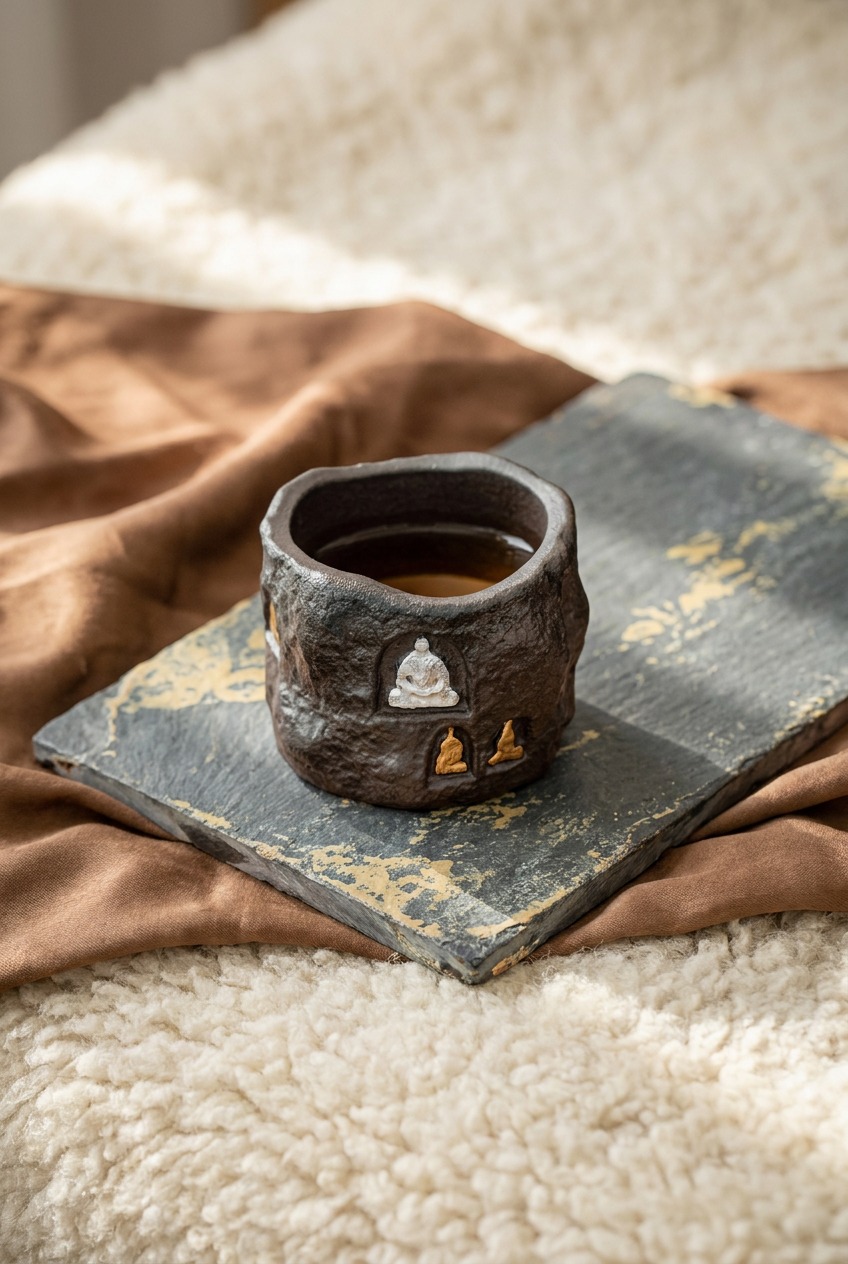
2. The Science Behind Porcelain vs Ceramic: Porosity and Vitrification
The term ceramic is a broad category: it encompasses earthenware, stoneware, and porcelain — all are ceramics in the technical sense. When people ask is ceramic porous, they are usually asking about the distinction between standard stoneware or earthenware and porcelain. The answer depends on firing temperature and clay body composition.
As Engineer Fix's materials science explanation of porosity explains, the critical process is vitrification — literally, turning into glass. Porcelain is made from refined kaolin clay with feldspar and quartz, fired at temperatures between 1,200°C and 1,400°C. At these temperatures, the feldspar and fluxing agents in the clay melt, filling the microscopic voids between particles and producing a dense, glass-like structure with a water absorption rate below 0.5%. This makes porcelain effectively non-porous: it cannot absorb tea compounds, oils, or minerals from repeated use.
Standard porous ceramic — stoneware and earthenware fired at lower temperatures — does not achieve the same degree of vitrification. A PMC-published study on sintering kinetics and vitrification paths in porcelain and stoneware found that porcelain and stoneware behave distinctly during sintering: porcelain's firing behaviour is essentially controlled by microstructural features, with the feldspar content producing a denser, more vitrified final body. Stoneware, with lower feldspar and higher mineral content, retains open porosity — typically with water absorption rates between 3% and 7% for semi-vitreous bodies. This open porosity is exactly what makes porous ceramics behave differently from porcelain as tea vessels.
The practical consequence: a porcelain cup presents a chemically inert, non-absorbing surface to the tea. Vitrified porcelain has no open pores for adsorption and no reactive minerals for ion exchange. It is what professionals use as the baseline in competitive tea evaluation — white porcelain is mandatory in quality grading and competition judging because it introduces no variable of its own. A porous ceramic cup, by contrast, participates in the brewing process: its open pores adsorb aromatic compounds, its mineral content can interact with tea polyphenols, and it accumulates a patina of tea compounds with repeated use that alters subsequent brews.
3. The Three-Material Framework: Porcelain, Glazed Ceramic, and Porous Stoneware
The most useful practical framework for types of tea cups by material, as articulated in the classical East Asian tea literature and confirmed by materials research, divides tea vessels into three functional categories based on what they do to tea rather than how they are classified.
Category 1: Porcelain — for preserving aroma
Porcelain's fully vitrified, non-porous body leaves tea completely unmodified. This makes it the correct choice when the priority is to experience the tea exactly as the producer made it — its inherent aromatics, its natural sweetness and astringency, its precision of character. In the material framework described by ceramics scholar Li Qizhang in The Beauty of Tea Vessels (九州出版社), porcelain suits fragrant, lightly fermented teas whose defining quality is high, volatile aroma: light and green oolongs, green tea, white tea, yellow tea, and young raw pu-erh (under three years). The porcelain's non-interference ensures those aromatics reach the drinker without attenuation.
Category 2: Glazed ceramic (陶, unglazed interior or plant/mineral-glazed) — for enhancing depth
Glazed ceramic occupies the middle ground. The glaze separates the clay body from the tea, moderating the direct interaction — but as Li notes, the clay body and the glaze still act on the tea, producing a modifying effect that glazed porcelain does not. The practical result is an enhancement of what he calls hóuyùn (喉韵) — throat finish, the sensation of the tea continuing to develop after swallowing. This makes glazed ceramic the appropriate choice for medium-to-heavily fermented teas whose reward is in their aftertaste rather than their immediate fragrance: mid-oxidation oolongs, roasted teas, pu-erh aged over three years, dark teas.
Category 3: Porous stoneware / rock-mineral clay — for transforming the liquor
Unglazed or partially-glazed porous ceramic stoneware — including rock-mineral clay (老岩泥) — interacts most directly with the tea. The open pores in the clay body adsorb aromatic compounds and volatile oils, the mineral content interacts with tea polyphenols, and the accumulated patina from repeated use modifies subsequent brews. Research on the effect of teapot materials on oolong tea composition found that clay vessels were particularly suited to oolong and dark teas, producing measurable differences in the composition and sensory profile of the resulting liquor. As our guide to rock-mineral clay explains, the quartz and mica particles in rock-mineral clay that remain unfused at firing temperatures around 1,250°C create a complex porous internal surface that interacts with tea in ways that vitrified porcelain cannot.
4. Oolong Tea and the Cup Question
A quick match-up, if you already know what you drink:
| Tea type | Recommended material | Why |
|---|---|---|
| Green tea, white tea | Porcelain | Preserves delicate aroma, doesn't retain flavour residue |
| Oolong | Glazed stoneware or rock-mineral clay | Balances aroma release with warmth retention |
| Pu-erh, dark tea | Rock-mineral clay | Porous surface interacts with tea over time, builds patina |
Oolong is the tea type where the porcelain vs ceramic question is most contested, and most interesting — because oolong is not one thing. It spans a wider range of oxidation levels than any other tea category: from the pale green, 10-15% oxidised Taiwanese high mountain oolongs to the deeply roasted, 70-80% oxidised traditional Wuyi cliff teas (岩茶). The same 'oolong' label covers teas whose optimal material pairing is at opposite ends of the spectrum.
Light, green oolongs (Alishan, Li Shan, Jin Xuan, light-style Tie Guan Yin): These teas are defined by their floral, high-register aromatics — the delicate fragrance that dissipates in the first seconds of exposure to air. Porcelain is the correct choice. The thin porcelain walls of a gaiwan or small porcelain cup allow fast temperature control, help preserve volatile aromatics, and present the tea's true character without modification. How to brew oolong tea of this style: use porcelain, keep water at 85-95°C, brew in short infusions (15-30 seconds), and smell the warmed cup lid after each pour to capture the most delicate aromatics.
Roasted and oxidised oolongs (traditional Tie Guan Yin, Wuyi cliff teas, Phoenix Dan Cong): These teas have already undergone transformation — through oxidation, roasting, and sometimes aging — that has shifted their reward from high fragrance to depth, body, and lingering throat finish. Here the porous ceramic cup begins to offer advantages. The iron compounds in rock-mineral or coarse stoneware clay can bind with some of the bitter polyphenols, softening astringency and letting the sweeter amino acids register more clearly. The porous surface's accumulation of tea compounds through repeated use creates a complementary substrate that develops alongside the tea.
The traditional principle yi qi yin cha (以器引茶) — "let the vessel lead the tea toward its best expression" — is not a constraint but a direction: it identifies which material amplifies the strengths of each tea style. For oolong, this means porcelain for aroma-forward styles, and porous ceramics for depth-forward styles. The boundary between the two is not fixed — it lies somewhere in the middle oxidation range where the drinker's own preference for aroma versus body determines the choice. As our guide to wood-fired ceramics and how kiln atmosphere shapes the surface explains, a wood-fired rock-mineral cup brings additional atmospheric variables — fire marks, ash deposits, specific mineral expression — that can further complement the complexity of a heavily roasted oolong.
A note on glazed-interior rock-mineral cups: Li Qizhang's The Beauty of Tea Vessels notes a specific case worth understanding: a rock-mineral cup with a glazed interior reduces the direct clay-tea interaction while retaining the tactile and visual character of the mineral body. This variant is suited to brewing high-quality tea whose true character you want to appreciate without modification — including lighter oolongs brewed in a mineral cup for its aesthetic and holding qualities. The glazed interior creates an effect closer to glazed ceramic than to unglazed porous stoneware.
5. Handmade vs Factory Made Ceramics: Why the Making Process Also Matters
The porcelain vs ceramic question concerns material type. But within any given material category, a second variable significantly affects the cup's behaviour: whether it was formed by hand or by industrial process. This is the dimension of handmade vs factory made ceramics — and it matters because the forming process directly affects the structure of the clay body.
Wheel-throwing and hand-building compress and orient the clay particles in specific ways during forming. The resulting body has variable wall thickness, physical compression from the forming process, and a surface that carries the marks of its making — all of which affect thermal behaviour, surface chemistry, and the specific way the cup interacts with the liquor it holds. Industrial slip-casting pours liquid clay into a mould: the clay particles deposit from suspension and dry in place without physical compression, producing a uniform wall thickness, a smooth interior surface, and a body structure that is consistent across thousands of identical pieces. As our detailed comparison of handmade vs machine-made ceramics explains, the surface of a hand-formed piece carries information — about the clay body, the forming process, the kiln — that a moulded piece structurally cannot.
For tea, this distinction becomes significant in porous ceramics specifically. The complex, varied surface of a hand-thrown or hand-built rock-mineral cup provides a more textured substrate for tannin adsorption and patina development than the smooth, uniform surface of a slip-cast equivalent. The quartz and mica particles that protrude from the surface of rock-mineral clay — which appear because they did not melt at the firing temperature — create attachment points for tea compounds that a smooth glaze does not offer. A rock mineral clay tea cup formed by hand and fired in a reduction kiln is, from this perspective, a more complex and responsive tea vessel than a machine-produced equivalent in the same nominal material.
6. A Practical Guide by Tea Type
The following guide applies the yi qi yin cha framework to the most common tea categories, using the material principles described above. These are guidelines rather than rules — the best way to verify any pairing is to brew the same tea in different cups and compare.
Green tea, yellow tea, white tea
Porcelain, always. These teas are defined by their clarity and fragrance. Any porous vessel will attenuate their most delicate aromatics. Use thin-walled porcelain, keep water below 85°C for green and yellow, and brew in a small cup that can be consumed quickly before the tea cools.
Light oolong (how to brew oolong tea — green, floral, light-oxidation styles)
Porcelain or glazed white ceramic is the traditional recommendation, and it remains correct for preserving the high register aromatics that define these teas. A glazed-interior rock-mineral cup is a viable alternative if the cup's aesthetic is important to you — the glaze sufficiently reduces the direct clay-tea interaction while allowing the cup's mineral character to remain present.
Medium oolong (traditionally-processed Tie Guan Yin, medium-roast Dan Cong)
This is the transition zone. Both porcelain and glazed ceramic types of tea cups work depending on your preference. If you value the tea's fragrance above all, use porcelain. If you are more interested in the tea's body and throat finish, try a glazed ceramic or a glazed-interior rock-mineral cup and compare. The difference is real and perceptible.
Roasted oolong (Wuyi cliff teas, charcoal-roasted Dan Cong)
Glazed ceramic or unglazed porous stoneware. The deep roasting has already transformed these teas' profile from fragrance-forward to body-forward. A porous ceramic cup's adsorption of some volatile compounds is not a loss here — it contributes to the perception of smoothness and depth that these teas offer at their best. Rock-mineral clay is particularly well-suited: the iron compounds in the mineral body interact with the tea's polyphenols in a way that can soften residual roughness from heavy roasting.
Raw pu-erh (under 3 years) and young sheng
Porcelain. Young raw pu-erh is high in catechins and has a brightness and astringency that porcelain presents most accurately. The original character of the leaf — the specific terroir, the specific processing — is most legible in a neutral vessel.
Aged raw pu-erh (3+ years), ripe pu-erh, dark tea, black tea
Porous stoneware, rock-mineral clay, or heavily-glazed ceramic. These teas have already developed complexity through fermentation and aging. A porous ceramic vessel that participates in the brew — adsorbing some compounds, contributing mineral interaction — adds to rather than detracts from the experience. As our guide to the first ritual of seasoning a cup explains, a rock-mineral or coarse stoneware cup dedicated to aged teas develops a patina that compounds the effect: after many sessions, the cup becomes an active participant in the flavour rather than a passive container.
Is ceramic porous? And does it matter for tea?
Yes, standard ceramic — stoneware and earthenware — is porous to a significant degree, with water absorption rates typically between 3% and 7% for semi-vitreous bodies. Porcelain, being fully vitrified at higher firing temperatures, has a water absorption rate below 0.5% and is effectively non-porous. Whether this matters depends entirely on what you drink: for teas where you want the cup to leave the flavour completely unmodified (delicate green oolongs, high-quality white teas, young pu-erh), non-porous porcelain is the correct choice. For teas where you want the cup to participate — to soften, deepen, and add body — porous ceramics are the correct choice.
How to brew oolong tea in a rock-mineral cup?
Use a rock-mineral cup for roasted, oxidised oolong styles — Wuyi cliff teas, traditional-process Dan Cong, charcoal-roasted Tie Guan Yin — rather than for light, green-style oolongs. Preheat the cup with hot water before pouring (this reduces the thermal shock and helps the cup's mineral surface interact with the tea consistently). Brew gongfu-style in short infusions of 15-30 seconds, progressively lengthening. The first few sessions in a new rock mineral clay tea cup may feel slightly neutral as the surface begins to season — after 20 to 50 sessions, the cup's interaction with the specific tea you use most will become more perceptible.
What is the difference between handmade vs factory made ceramics for tea?
The forming process affects the clay body's structure, the wall thickness distribution, and the surface character — all of which influence how the cup behaves with tea. Hand-formed cups have variable wall thickness that creates different thermal profiles across the piece, physical compression from the throwing process that gives the body greater structural resilience, and a surface that carries the marks of its making (throwing ridges, mineral protrusions, kiln atmosphere marks). These are not merely aesthetic differences: they affect how the cup holds heat, how its surface interacts with tea compounds, and how its patina develops across use. For porous ceramic cups specifically, hand-forming produces a more complex surface substrate for tea interaction than slip-casting. The choice between handmade and factory made ceramics is not a choice between quality levels — it is a choice between different functional and experiential profiles.
Can I use the same cup for different teas?
For porcelain, yes — its non-porous surface means there is no meaningful accumulation of compounds from previous brews, and it can be used for any tea without cross-contamination concerns. For porous ceramics and unglazed stoneware, mixed use is possible but affects the cup's development: a cup used for many different teas develops a more complex, less focused patina than one dedicated to a single tea category. Many experienced practitioners dedicate each porous clay cup to one type of tea for this reason — but this is a preference rather than a requirement. If you have one cup and brew many types of tea in it, simply rinse thoroughly between different teas and understand that the cup's seasoning effect will be more generalised.
A Final Note
The question of porcelain vs ceramic for tea is ultimately a question about what you want the cup to do. Porcelain guarantees neutrality — the tea speaks for itself, unmodified. Glazed ceramic adds depth and throat finish without overwhelming the tea's character. Porous stoneware transforms the liquor — participating actively in the brew, softening some qualities and amplifying others, developing over time in response to the specific teas you choose. None of these is inherently superior. Each suits a different kind of drinker and a different set of priorities. The best cup is the one that does what you want, with the teas you drink, in the way you drink them. Understanding the material science is simply the shortest route to knowing which one that is.
Related Articles
The Art of Caring for Your Tea Cup: A Wabi-Sabi Pottery Guide
Tea Rituals for the Spiritual but Not Religious
References
1. Yixing ware — Mineral Composition, Porosity and Tea Interaction. Wikipedia. https://en.wikipedia.org/wiki/Yixing_ware
2. Is Porcelain Non-Porous? Explaining the Science of Vitrification and Porosity. Engineer Fix. https://engineerfix.com/is-porcelain-non-porous-explaining-the-science/
3. Porcelain versus Porcelain Stoneware: Sintering Kinetics, Phase Evolution and Vitrification Paths. PMC / MDPI Materials. https://pmc.ncbi.nlm.nih.gov/articles/PMC9821833/
4. Effect of Teapot Materials on the Chemical Compositions of Oolong Tea Infusion. ResearchGate (Liao et al., 2017). https://www.researchgate.net/publication/318203705
5. "以器引茶" — Material-Tea Pairing Framework. 李启彰《茶器之美》北京:九州出版社.


