Contents
The question of handmade versus machine-made ceramics is often framed as an aesthetic one: handmade pieces have charm and character, machine-made pieces have consistency and precision. Both of these observations are true, but they describe the surface of a deeper difference. The real distinction between a wheel-thrown stoneware cup and a slip-cast production mug is not primarily visual. It is structural — a consequence of how each forming method interacts with clay at a molecular level, and what that interaction leaves behind in the body of the finished object. Understanding this distinction is useful for anyone who chooses objects for their home with more than appearance in mind.
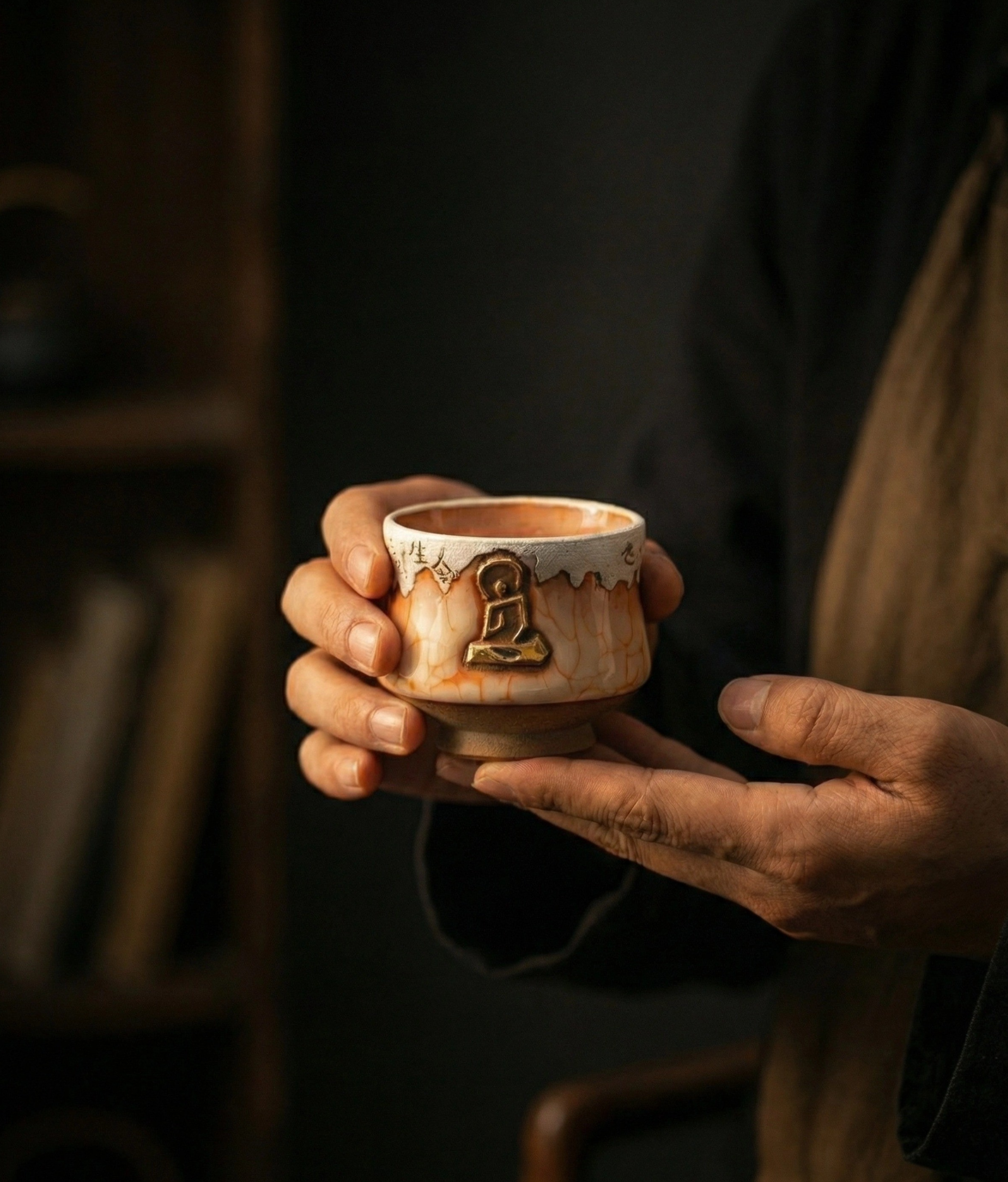
This article looks at the production processes on both sides, what they produce structurally and tactilely, and why these differences matter for pottery decor that is intended to be used, held, and lived with over time — not simply placed on a shelf and looked at.
1. How Machine-Made Ceramics Are Actually Produced
Industrial ceramic production uses several forming methods, each optimised for a different type of output. The three most common are slip casting, jiggering and jollying, and isostatic pressing.

As Wikipedia's entry on slip casting explains, slip casting involves pouring a deflocculated liquid clay slurry — called casting slip — into a plaster mould. The plaster absorbs water from the slip, and a layer of clay builds up against the mould wall. When this layer reaches the required thickness, the remaining slip is poured out; the cast stiffens, shrinks slightly away from the mould, and is removed for drying and firing. The technique is suited to complex shapes and fine, thin-walled ware, and has been widely used in industrial production since it was developed in 18th century England. Its defining characteristic is that the clay is always in a liquid or near-liquid state when it enters the mould — meaning that the piece never goes through the process of plastic deformation under applied force.
Jiggering and jollying, as described in DigitalFire's technical reference, is a mechanised process in which soft clay is pressed against a rotating plaster mould by a profiled template — producing plates, bowls, and cups with high dimensional consistency and smooth interior or exterior profiles. The key advantage of jiggering is speed and uniformity: every piece made in the same mould with the same template is, within tight tolerances, identical. The key consequence is that the clay is shaped by mechanical pressure rather than by the hands of a maker, and the surface of the finished piece reflects this — smooth where the template ran, carrying no information about a forming process.
Isostatic pressing, used primarily for flatware, involves pressing powdered or semi-dry ceramic material into shape under high hydraulic pressure. The result is a dense, dimensionally accurate piece with very consistent material properties — well-suited for tableware that needs to perform identically across large production runs. What it cannot produce is a surface that carries any evidence of its making, because the forming process involves no interaction between human hands and clay.
2. How Hand-Formed Ceramics Are Actually Produced
Hand-forming encompasses several techniques, of which wheel-throwing and hand-building are the most significant for the production of vessel forms.
Wheel-throwing involves centring a ball of plastic clay on a rotating wheel-head and using applied hand pressure to open the clay, raise the walls, and refine the form. The process requires the clay to be in a plastic state — neither too wet nor too dry — and it is the interaction between the moving clay and the specific pressure of specific hands that determines the final form. Every decision about wall thickness, curve, rim profile, and foot is made tactilely, in real time, as the clay moves. The finished piece carries the record of these decisions in its structure: variations in wall thickness that follow the logic of the maker's technique, surface marks that record the contact between hands and clay, a form whose every dimension was arrived at through physical negotiation rather than mechanical specification.
Hand-building — including coiling, pinching, and slab construction — produces forms that are even more directly shaped by manual force: each coil joined, each pinch made, each slab curved and trimmed. The resulting pieces tend to have less formal regularity than thrown work, but the structural logic of the making process is even more legible in the finished object. As our guide to wood-fired pottery explains, when a hand-formed piece goes through a high-temperature wood firing, the interaction between the clay body and the kiln atmosphere adds another layer of information to the surface — fire marks, ash deposits, atmospheric colour changes — that machine-formed ware cannot receive in the same way because its surface is too uniform to hold these variations distinctively.
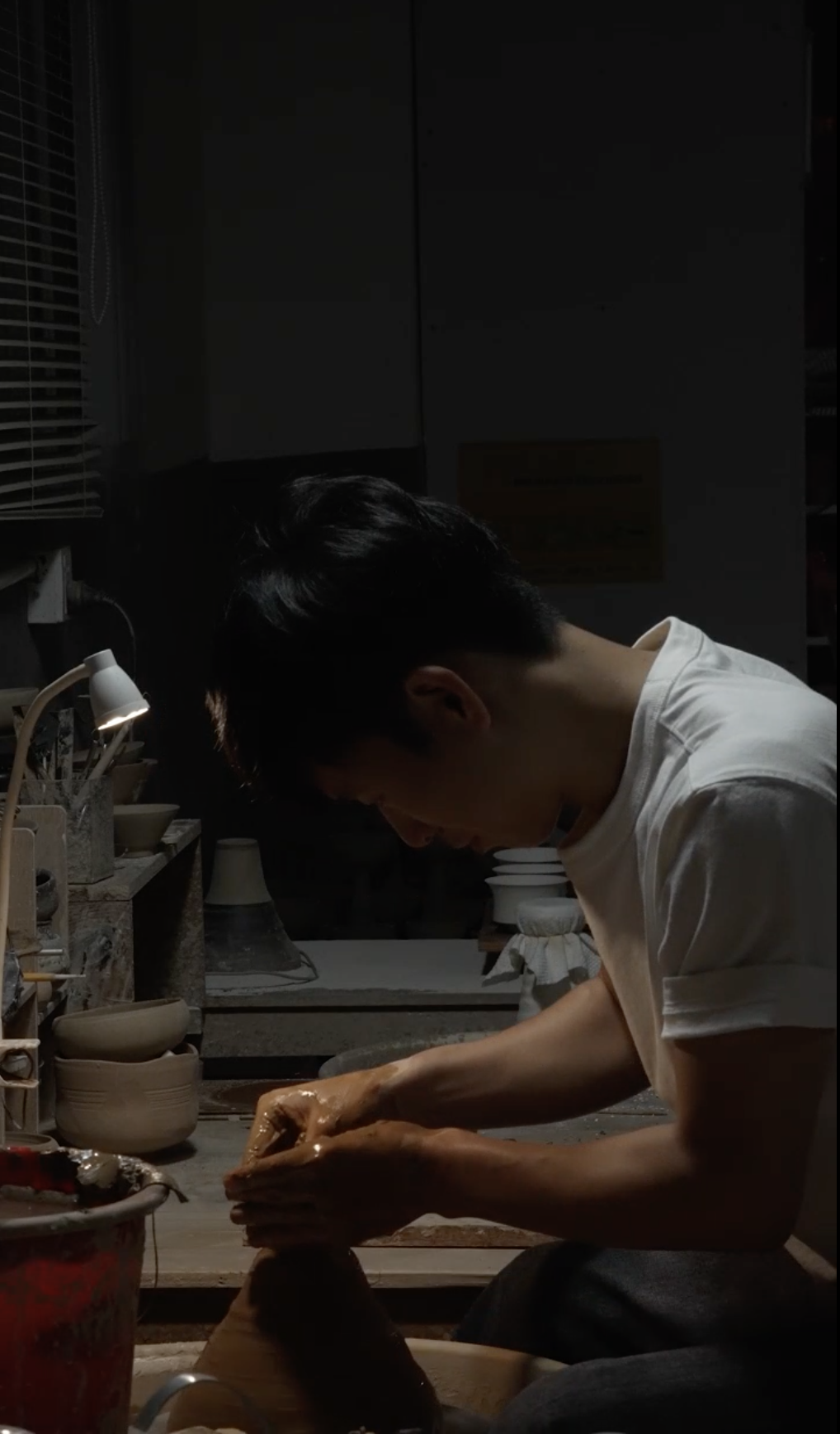
Before the surface, the hands. Wheel-throwing requires the clay to be in plastic state — neither too wet nor too dry — shaped in real time by applied pressure rather than by a template. What the hands decide here is what the finished piece carries. No mould records this. Only the clay does.
The two production methods, side by side:
|
Machine-made (slip cast / jiggered) |
Handmade (wheel-thrown / hand-built) |
| Clay state during forming |
Liquid or semi-dry, shaped by mould |
Plastic, shaped by hand pressure |
| Wall thickness |
Uniform throughout |
Variable — thicker at base, thinner at rim |
| Particle orientation |
Deposited from suspension, no compression |
Compressed and aligned, more structurally resilient |
| Surface |
Records the mould — smooth, no trace of process |
Records the maker's hands — spiral marks, density variation |
| What it can't do |
Carry evidence of a forming process |
— |
3. What the Forming Method Leaves Behind: Density, Wall Thickness, and Structure
The difference between hand-formed and machine-made ceramics is not only visible — it is structural. Several specific differences in the material properties of the finished piece follow directly from the forming method.
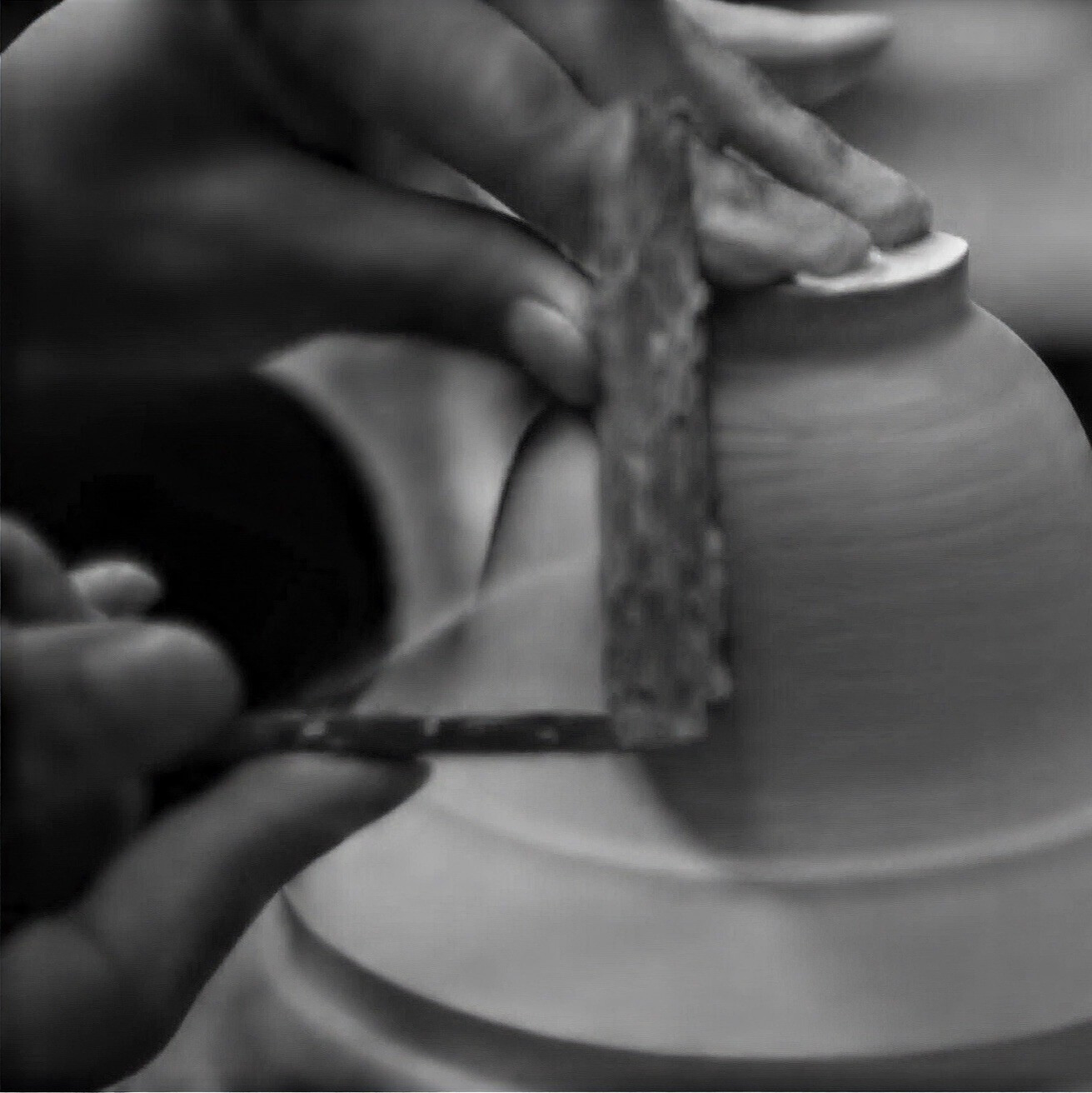
The trimming tool, the spinning clay, the spiral left by the throw still visible in the body. This is the moment that separates handmade ceramic art from slip-cast production: a decision made by a hand, recorded in the material, present in the finished piece every time it is held.
Wall thickness and uniformity. Slip-cast ware has consistent wall thickness by construction: the cast layer builds evenly against the mould surface, and the result is a piece with uniform walls throughout. Wheel-thrown ware, shaped by hand pressure, typically has variable wall thickness — thicker at the base, thinner at the rim, with gradations that follow the logic of how pressure was applied during throwing. This is not a defect. Variable wall thickness affects how heat is distributed through the piece when it holds hot liquid, how the object feels in the hand at different points of contact, and how it responds to the thermal cycles of use over time.
Clay body compression and orientation. When clay is shaped by hand on a wheel, the plastic clay body is subjected to compression and shear forces that align the clay particles in specific ways — a phenomenon called particle orientation. This gives wheel-thrown ware a particular structural character that slip-cast ware, whose clay particles are deposited from suspension and dry in place rather than being physically compressed, does not have. The practical consequence is that hand-thrown pieces tend to have greater structural resilience — they are less prone to cracking under thermal stress — and a denser, more tactilely substantial feel.
Surface character. The surface of a slip-cast piece records the surface of the mould it was formed in. If the mould is smooth, the piece is smooth; if the mould has texture, the piece replicates it. The surface of a wheel-thrown piece records the hands that made it: fine spiral ridges from the throwing process, variations in clay density that create subtle undulations, the specific response of that clay body to that maker's pressure. These are not imperfections. They are the forming process made visible — a record of physical interaction between maker and material that no mould-based process can replicate.
4. The Tactile Dimension: Why Surface Complexity Matters More Than It Seems
Touch is the first sense humans develop, and research in consumer psychology has established that tactile experience plays a significant role in how objects are evaluated, valued, and emotionally connected to. A systematic review of tactile perception research published in Frontiers in Psychology found that affective attachment experienced during tactile exploration is a strong driver of product preference — that how something feels when held has a direct relationship to how much it is valued, independent of its visual appearance.
Research on tactile aesthetic appreciation published in Psychology & Marketing found that consumers' tactile appreciation follows what the researchers call a Unity-in-Variety principle: objects are most appreciated tactilely when they offer variety — complexity, variation, differentiated surface features — within a coherent overall form. A surface that is entirely smooth and uniform offers too little variety to engage sustained tactile attention. A surface with deliberate variation — the spiral ridges of a thrown cup, the mineral protrusions of rock-mineral unglazed stoneware, the fire marks of a wood-fired piece — offers the kind of complexity that the hand continues to find interesting across repeated contact.
A study on consumer needs for hand-touch products published in MDPI Sustainability found that hand-touch products — objects in which the maker's hands are present in the surface — generate sensory stimulation and create memorable experiences that drive purchase decisions and long-term attachment. The study distinguished hand-touch products from machine-made alternatives not on grounds of quality or durability, but on grounds of experience value: the specific kind of sensory and emotional engagement that only an object made by hands can produce. As our guide to the earthy aesthetic and tactile mindfulness explores, this distinction is particularly significant for objects that are held in daily use — a tea cup, a small vessel, a piece of pottery decor that the hands return to every day.
What the research found:
| Source |
Key finding |
| Frontiers in Psychology |
Tactile experience drives product preference, independent of visual appearance |
| Psychology & Marketing |
Surfaces with variety-within-form ("Unity-in-Variety") are most appreciated tactilely |
| MDPI Sustainability |
Hand-touch products create memorable experiences that drive attachment and purchase decisions |
5. Surface Information: What a Handmade Piece Carries That a Machine-Made One Cannot
The surface of a handmade ceramic piece carries information that a machine-made piece structurally cannot. This is not a matter of applied decoration or deliberate surface treatment — it is a consequence of the forming process itself.
A wheel-thrown cup has a surface that records the specific sequence of pressures, speeds, and decisions that produced it. The slight spiral of the throwing marks, the way the clay thickened at the base and thinned at the rim, the specific response of a particular clay body to a particular maker's hands on a particular day — these are all present in the finished object, not as decoration but as structural fact. The surface is not designed. It is a record.
When this kind of piece is fired in a wood kiln, a further layer of information is added: the marks of ash, flame, and atmosphere that wood-fired ceramics carry. The side of the piece that faced the firebox is marked differently from the side that faced away. The accumulation of ash glaze records where ash happened to land. The fire marks record the specific atmospheric conditions in that part of the kiln at the peak of the firing. None of this can be added after the fact. It is all the record of something that happened — once, in a specific kiln, under specific conditions — and is now permanently fused into the clay body.
A slip-cast production piece has no equivalent record. Its surface records the surface of the mould it was made in: smooth, consistent, carrying no information about a forming process because the forming process was designed to leave no trace. This is not a criticism — it is the definition of successful industrial production. But it means that the surface of a machine-made piece is, in an information sense, empty. There is nothing in it to discover on the second or tenth or hundredth encounter that was not apparent on the first. As our exploration of why handmade objects become more meaningful over time argues, objects whose surfaces reward sustained attention — that offer something to find at the tenth look that was not obvious at the first — hold their value in daily life differently from objects that are fully legible at first glance.
6. Pottery Decor and the Difference That Holds Up Over Time
The implications of these structural and tactile differences are most relevant when choosing objects for daily use rather than display. A pottery decor piece that sits on a shelf and is never touched is less affected by these distinctions than one that is held every morning, washed and dried by hand, used for hundreds of tea sessions over years.
For objects in daily use, the forming method matters in several specific ways. A hand-thrown cup with variable wall thickness holds heat differently than a slip-cast cup with uniform walls: the variation in wall thickness creates different thermal profiles across the piece, affecting how warmth distributes to the hand. A piece with a rugged aesthetic — the mineral surface of rock-mineral clay, the fire marks of wood firing, the throwing ridges of wheel-thrown work — provides the tactile complexity that makes repeated daily contact more interesting than it would be with a smooth, uniform surface. And a piece whose surface records something real — a forming process, a firing, a specific interaction between maker and material — continues to offer this information across years of use in a way that a piece designed to conceal its origins does not.
This is the practical argument for handmade ceramic art as pottery decor: not that it looks better — though it often does — but that it holds up differently. It wears in rather than wearing out. The surface that seemed rough on first contact becomes familiar. The variation that seemed imprecise becomes the specific character of that specific piece. The record of its making, which was always present in the clay body, becomes legible over time to the hands that hold it daily. This is what machine-made ceramics, however well-made, cannot offer — not because of a failure of craft or care, but because the forming process that made them was designed to produce uniformity, and uniformity, in daily use, has a ceiling.
7. Frequently Asked Questions
Is there a practical quality difference between hand-thrown and slip-cast ceramics, or is it only aesthetic?
There are practical differences, though they vary by application. For vessels used to hold hot liquids — tea cups, small bowls — the variable wall thickness of hand-thrown work produces different heat distribution characteristics than the uniform walls of slip-cast ware: heat is retained differently, and the thermal profile the hand encounters varies across the piece in ways that many people find more pleasurable in sustained use. For durability under thermal stress, hand-thrown pieces fired from coarser, more refractory clay bodies tend to be more resilient than thin-walled slip-cast pieces, because the physical compression of the throwing process aligns clay particles in ways that improve structural integrity. For visual consistency across a set, slip-cast wins decisively. The practical differences are real but context-dependent: what matters is what the object will be used for.
Why does unglazed stoneware feel different from glazed production ceramics?
Several reasons, all related to what the surface is and is not. A glazed production ceramic has a glassy layer over its surface — chemically inert, smooth, reflecting light uniformly. The hand contacts the glaze rather than the clay body beneath it. Unglazed stoneware — whether wood-fired ceramics with natural ash deposits, or rock-mineral clay with its protruding quartz and mica particles — presents the clay body directly to the hand. The surface is the material, not a coating over it. This means the tactile experience is of something with genuine physical character: variable texture, slight roughness, the thermal conductance of dense fired clay rather than glass. It also means the surface can develop a patina with use — absorbing the oils of the hands that hold it, building the kind of familiarity that a glaze, being chemically sealed, cannot develop in the same way.
How do I tell the difference between a genuinely handmade piece and a machine-made piece designed to look handmade?
Several indicators are reliable. First, look at the bottom of the piece — the foot ring and base. A genuinely hand-thrown piece will typically show trimming marks on the foot ring from when it was cut and refined on the wheel; these marks are irregular in a specific way that mechanical trimming is not. Second, hold the piece and rotate it slowly: a hand-thrown piece will have slight variations in wall thickness that you can feel as you move your hand along the surface, as well as very faint spiral ridges from the throwing process. A slip-cast piece will feel uniformly thin throughout. Third, look at the rim: on a hand-thrown piece, the rim is almost never a perfect circle when viewed from above, and its profile when viewed from the side shows slight variations in thickness and height. A machine-finished rim is perfectly level and uniform. Fourth, ceramic art that is genuinely hand-formed from dense, mineral-rich clay bodies will have a specific weight and density that thin-walled slip-cast ware does not — the heft of a well-thrown cup made from coarse stoneware clay is distinctly different from the light, consistent weight of a production mug made from refined casting slip.
A Final Note
The distinction between handmade and machine-made ceramics is not primarily about which is better. It is about what each type of object is. A machine-made cup is designed to be identical to every other cup made in the same run — its value is in its consistency, its affordability, its ability to fulfil its function reliably without variation. A handmade cup is designed to be specific: to that clay body, that forming session, that firing. Its value is in its particularity — in the surface that records what happened to it, and the way that record becomes more legible over time to the hands that hold it. Both are legitimate objects. But they offer different things, and understanding what those things are makes it easier to choose which kind of pottery decor belongs in your home.
References
Related Articles


