Contents
A cacao ceremony is, on the surface, a simple thing: a small group (or one person, alone) drinks a thick, bitter, unsweetened cacao drink, usually in the morning, usually with some kind of shared intention for the time that follows. What makes it a "ceremony" rather than "having a hot chocolate" is almost entirely a matter of attention — how the drink is made, how it is held, how long people sit with it before moving on.
This raises a question that is easy to overlook: if the ceremony is mostly about attention, does the vessel matter? The cacao itself has been studied — there is real research on what flavanol-rich cacao does to mood. But the cup is part of the ceremony too, in ways that are worth being specific about.
1. What a Cacao Ceremony Actually Is
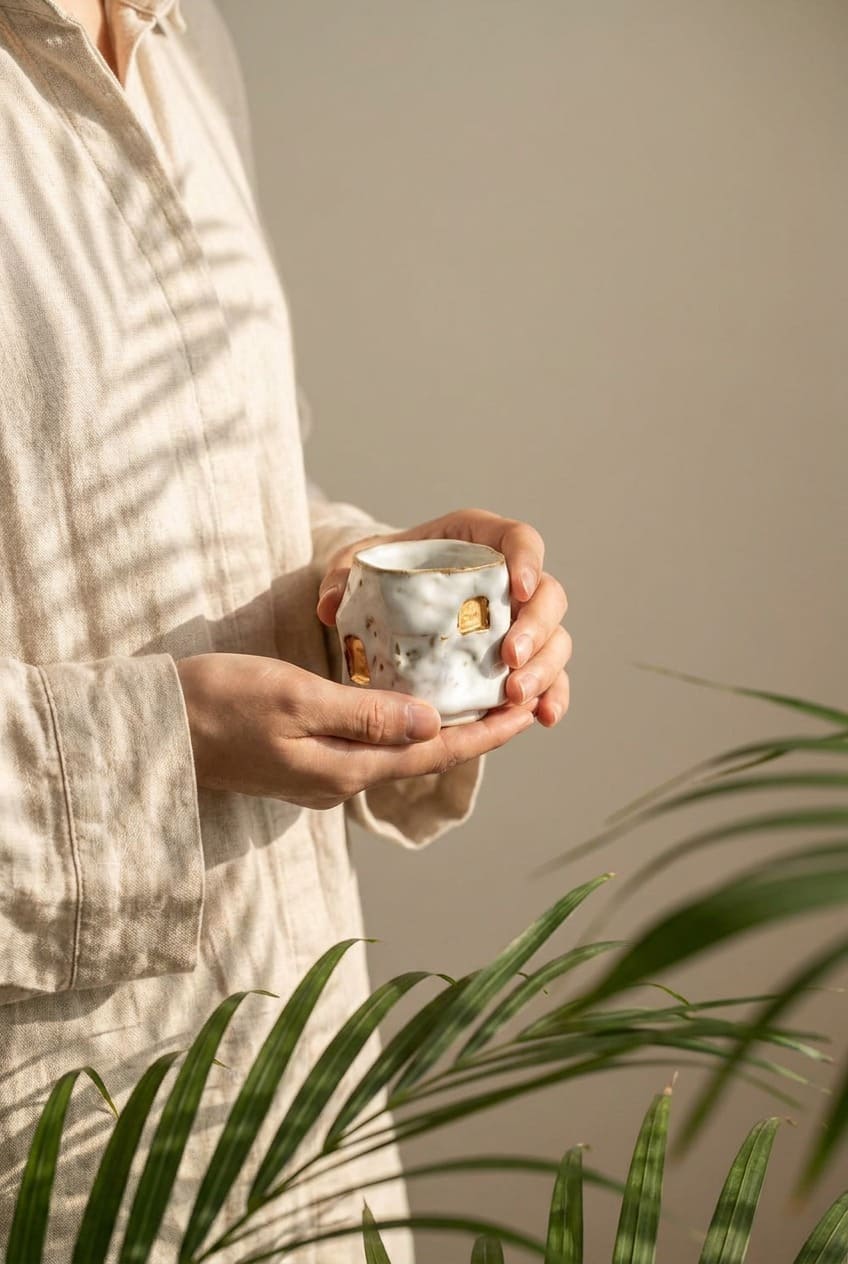
Ceremonial cacao is different from the cocoa most people grew up with. It is minimally processed, unsweetened, and consumed in a higher dose than a casual hot chocolate — often 20 to 40 grams, prepared with hot water or milk and little else. The "ceremony" part refers to the structure around drinking it: an intention is often set before drinking, the cup is held with both hands, and the time afterward — typically 20 to 60 minutes — is kept free of screens and unrelated tasks.
Many people find their way to a cacao ceremony through the same door as other morning practices — a search for something that anchors the start of the day. Our guide to the morning ritual covers the broader window this fits into: the first 30 to 60 minutes after waking, when the brain is unusually receptive to whatever tone is set. A cacao ceremony is one specific way to occupy that window — deliberately, with both hands around something warm.
2. What the Research Says About Cacao
Separate from the ceremonial framing, there is a body of research on what cacao flavanols do physiologically. The most directly relevant study is a randomized, double-blind, placebo-controlled trial published in Nutrients in 2023. Researchers gave 60 women aged 40-60, all reporting fatigue, either a flavanol-rich cacao extract (240mg/200mL daily) or a placebo, for eight weeks.
The result: negative mood indicators — depression, fatigue, and anger — along with the total mood disturbance score, were significantly lower in the cacao group than the placebo group after the eight weeks. This is a real, measured effect on mood state, not a self-reported impression.
It is worth being precise about what this study does and does not show. It does not say that cacao "opens the heart" or facilitates anything mystical — that framing belongs to the ceremonial tradition, not the research. What it shows is narrower and, in its way, more useful: regular intake of cacao flavanols, over weeks, is associated with a measurable reduction in negative mood states. The ceremonial ritual and the biochemistry are two separate things that happen to point in the same direction — much like the relationship between ritual and the placebo mechanisms covered in our guide to moon water rituals, where the practice and the substance each contribute something, without either needing to borrow the other's explanation.
3. The Ritual Dimension: Why the Cup Is Not Incidental
If the biochemical effect builds up over weeks, what is happening in any single ceremony? This is where the structure of the ritual — and the object at its centre — does its work.
Holding a cup with both hands for an extended period is a small, specific physical act, and it is one that our guide to tea meditation covers in more depth: the weight and warmth of a vessel held in both hands is a point of contact that the wandering mind can return to. In a cacao ceremony, this isn't incidental — the cup is often held for the full duration, refilled rather than set down, making it the one constant physical anchor for the entire practice.
The intention-setting that often opens a cacao ceremony follows the same logic explored in our piece on moon water rituals: a stated intention, held in mind while doing something physical and deliberate, is one of the conditions under which ritual produces real psychological effects. In a cacao ceremony, the "something physical and deliberate" is largely the cup — picking it up, holding it, drinking slowly, setting it down only when the cacao is finished.
None of this requires the cup to be special in any mystical sense. But a cup that is pleasant to hold for 20-60 minutes — that doesn't need to be set down because it's uncomfortable, that has enough presence to stay interesting as a point of attention — does more of this work than one that doesn't.
4. Why This Cup Doesn't Burn Your Hands
| Vessel Material |
Porosity & Structure |
Thermal Conductivity (Phonon Path) |
Tactile Experience (During 20-60 Min Ritual) |
Coarse Stoneware Clay
(e.g., Rock-Mineral Clay) |
High porosity, coarse-grained with micro air pockets (natural insulation). |
Low Conductivity |
Transfers heat slowly. Soft, sustainable warmth that is comfortable to hold with both hands continuously. |
| Porcelain / Thin Ceramic |
Dense, vitrified crystal lattice with zero or low porosity. |
High Conductivity |
Transfers heat rapidly. Becomes "too hot to hold" almost immediately, forcing the user to set it down. |
Ceremonial cacao is served hot — and held, continuously, for far longer than a quick coffee. This makes one practical question more important here than almost anywhere else: why is my mug too hot to hold?
Heat moves through a ceramic vessel via phonons — vibrations passing through the material's crystal lattice. Research on ceramic thermal conductivity confirms that the porosity of a ceramic body directly affects this: a dense, low-porosity material gives heat a continuous path to travel quickly to the surface, while a porous, coarse-grained material interrupts that path. The air pockets within a porous structure act as insulation — and the heat takes measurably longer to reach your hand.
This is the difference between a thin porcelain cup and a thick, stoneware tea cup made from coarse, mineral-rich clay. Our guide comparing porcelain and ceramic tea cups covers this in the context of tea, but for a cacao ceremony — where the cup is held continuously rather than sipped and set down — the effect is more pronounced. A dense, thin-walled vessel transfers heat quickly: comfortable for a moment, then too hot, then set down. A thick-walled, porous, mineral clay vessel transfers heat slowly — the warmth arrives gradually, settles, and stays at a level that can be held rather than endured.

Deciding what cup to use for cacao ceremony is often about finding meaning; this beautiful design can also serve as a traditional water offering Buddhism vessel.
The Stone Sanctuary is built on exactly this principle. Its walls are noticeably thicker than a standard mug, made from a rock-mineral clay body with the coarse, granular structure that interrupts heat flow. Held through a full cacao ceremony, the difference is not subtle — the warmth is present throughout, without ever becoming the reason you need to put the cup down. Warm in the hand. Not burning. The difference is in the walls.
5. Beyond Cacao: The Same Cup on a Water Offering Altar
The same vessel that holds cacao for an hour can, on other mornings, hold something else entirely. Water offering Buddhism traditions — small bowls of fresh water placed on a home altar each morning — use vessels in roughly the same size range as a cacao cup, for an entirely different purpose: not to be drunk slowly, but to be placed, looked at, and refreshed daily.
This kind of water offering Buddhism practice doesn't require a separate vessel from the one used in the morning — the same cup can serve both, at different hours.
What connects these two uses is not the liquid, but the structure: an object, held or placed with attention, on a daily or near-daily rhythm. Our guide to Buddhist imagery in everyday objects explores how a seated, meditative figure functions as a visual anchor for this kind of space — and the same cup that serves a cacao ceremony in the morning can sit, empty or filled with water, on that same altar for the rest of the day. The object doesn't need a different identity for each use. Its presence is consistent; only its contents change.
For anyone drawn to the night-sky imagery covered in our piece on moon water rituals, Cosmic Bloom — with its mineral crystal surface catching points of red and blue light across a rough texture — works as well on an altar shelf as it does for an evening ritual. The same object, the same surface, doing different work depending on the hour.
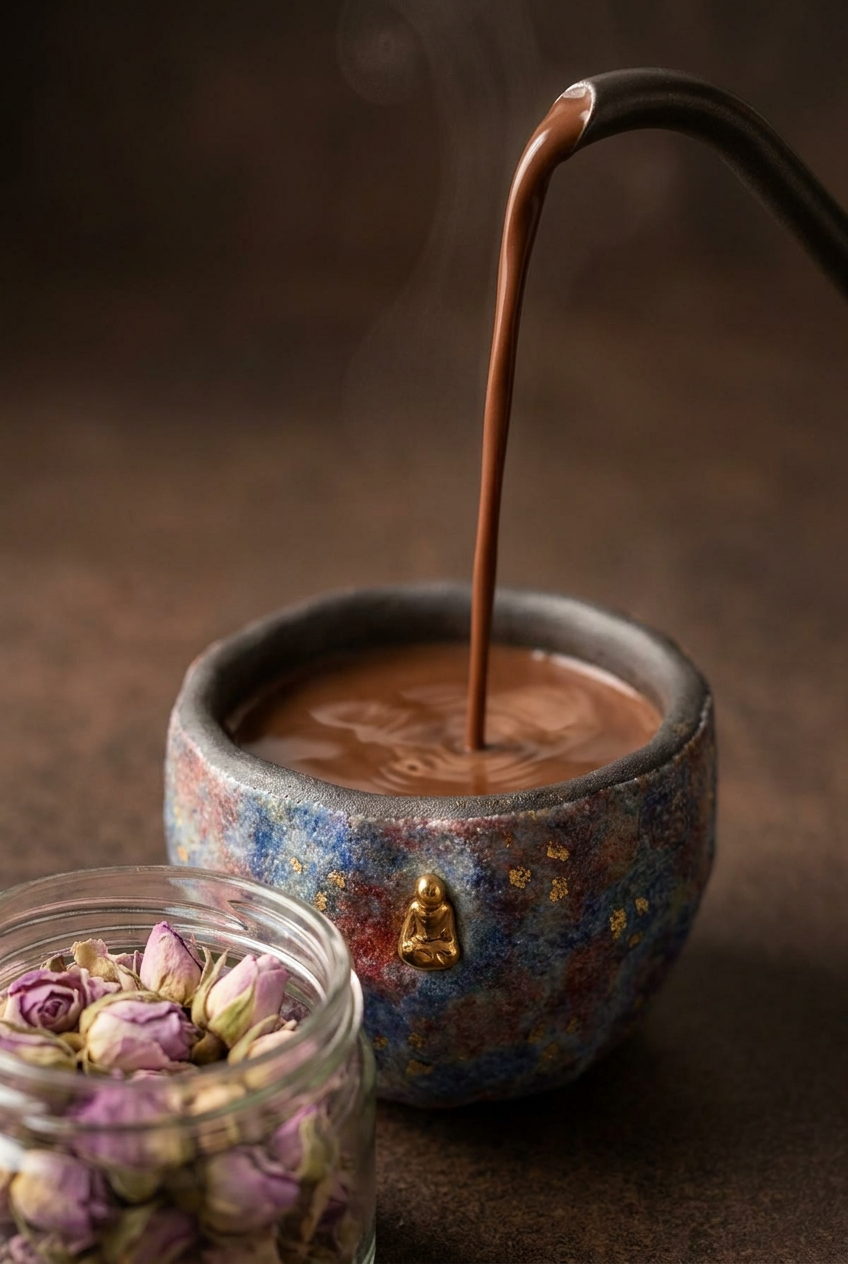
This versatile ceremonial cacao mug, seen here next to a jar of fragrant dried rosebuds, is also perfectly suited for water offering Buddhism rituals, connecting two powerful ancient traditions.
6. Choosing Your Ceremony Cup
| Ritual Scenario |
Recommended Capacity |
Key Vessel Requirements |
Ritual Purpose & Anchor |
Cacao Ceremony
(Full Active Dose) |
150ml - 250ml |
Thick insulated walls, heavy base, textured surface that rewards tactile mindfulness. |
Sipped slowly over a 20-60 minute screen-free window; serves as a physical grounding anchor. |
Cacao Ceremony
(Concentrated/Half Dose) |
100ml - 150ml |
Thick walls, compact wabi-sabi shape to hold concentrated warmth in the palms. |
Ideal for beginners or quick morning intention-setting routines. |
Water Offering Buddhism
(Altar Ritual) |
100ml - 200ml |
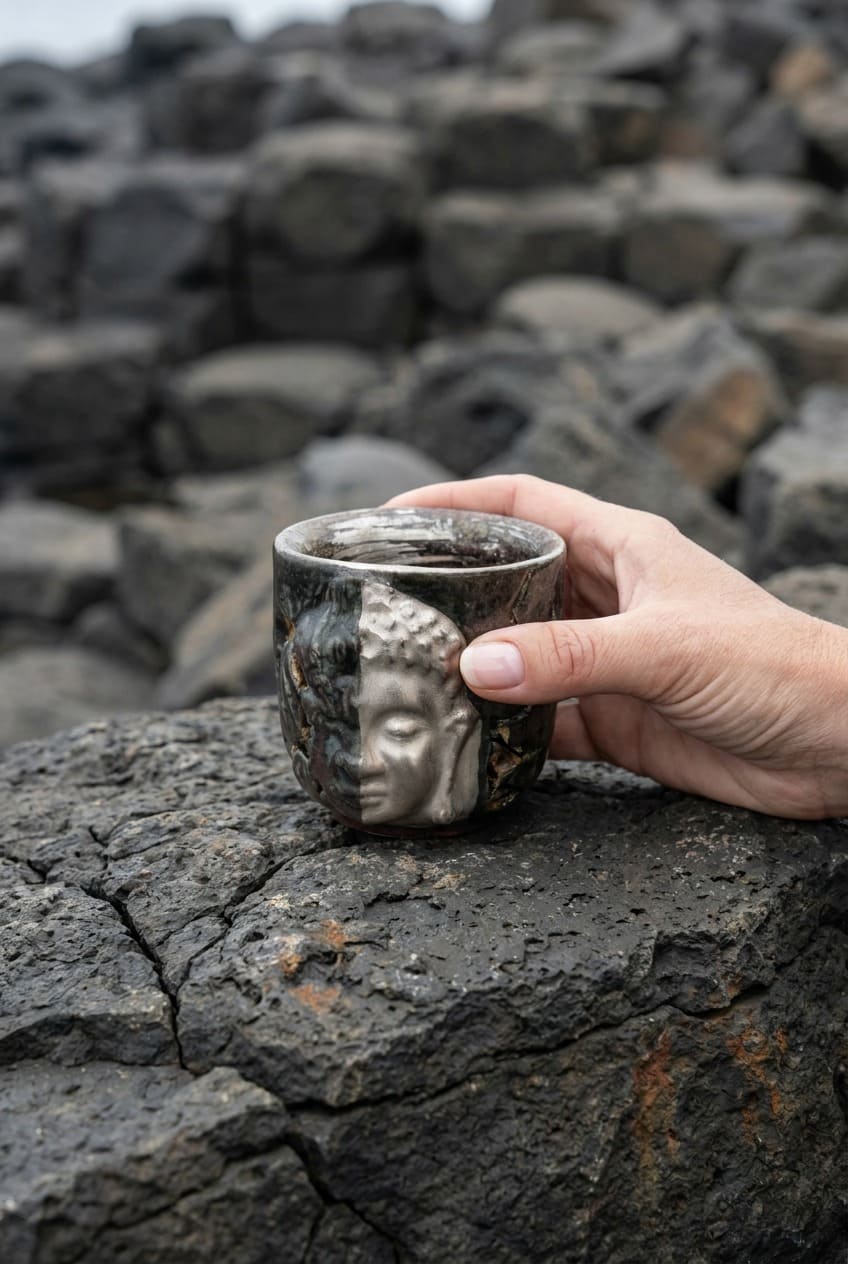
Sacred/mindful visual imagery (e.g., Buddha relief), stable footprint, serene aesthetics. |
Placed on the home altar, refreshed daily with fresh water to cultivate purity and respect. |
A few practical criteria, drawn from the sections above:
Weight and warmth retention. For a ceremony held in both hands for 20-60 minutes, a thick-walled, porous-clay vessel — like The Stone Sanctuary — keeps the warmth steady without becoming uncomfortable.
A surface that rewards attention. Since the cup is a point of focus for an extended period, texture and visual interest matter more here than in a quick-use vessel. A smooth, uniform surface gives the wandering mind less to return to.
One cup, used consistently. The 90% rule described in our wabi-sabi sanctuary guide applies directly here: a cup leaves the kiln roughly 90% complete, and the remaining 10% — the patina, the specific marks of repeated use — comes from exactly this kind of regular ritual. A cacao ceremony, done with the same cup each time, completes the piece in the way nothing else can.
7. Frequently Asked Questions
What size cup should I use for a cacao ceremony?
A typical ceremonial dose (20-40g of cacao paste, mixed with 150-250ml of hot water or milk) fits comfortably in a cup of roughly 150-200ml. What cup to use for cacao ceremony purposes ultimately depends on dose — a smaller, more concentrated serving (closer to 100ml) works for a half-dose or for someone new to ceremonial cacao, while a fuller 200ml+ cup suits a full ceremonial dose meant to be sipped slowly over an hour.
Is a ceremonial cacao mug different from a regular mug?
Not in any formal sense — there is no certification or specific design that makes a mug "ceremonial". What distinguishes a cacao ceremony cup in practice is usually some combination of: handmade rather than mass-produced, a material that retains heat well (see Section 4), and — often — a single dedicated cup used specifically for this practice, separate from everyday use. The dedication is what makes it ceremonial, not any feature of the object itself.
Can I use the same cup for tea, cacao, and water offerings?
Yes — and there is an argument that doing so is preferable to having a separate vessel for each. A cup used across multiple daily rituals accumulates patina and meaning faster than one reserved for a single use, and the consistency of "this is the cup" — regardless of what is in it — is itself part of what gives a ritual its anchoring effect.
A Final Note
The research on cacao flavanols is real, and so is the research on ritual and attention. Neither one requires the other to be true for both to matter. What a cacao ceremony offers — a warm weight held in both hands, for longer than usual, with nowhere else to be — is something a cup can either support or work against. The right one disappears into the practice. The wrong one keeps reminding you it's there, usually by getting too hot to hold.
Related Articles
References


