Contents
There is a category of beauty that cannot be designed — only invited. The surface of a wabi sabi ceramics piece that has passed through a high-temperature reduction firing carries colours, marks, and textures that the maker set in motion but did not determine. The copper that turned from green to deep red. The iron that pooled into a dark, almost metallic band at the base of the glaze. The ash that settled on one shoulder of the cup and melted into a amber streak that runs to the foot. None of this was drawn or planned. It happened, inside a kiln, at temperatures above 1,250°C, governed by chemistry and atmospheric conditions that no human hand can fully control. This is the aesthetic of kiln transformation — and it is why each piece is not just unique, but genuinely unrepeatable.
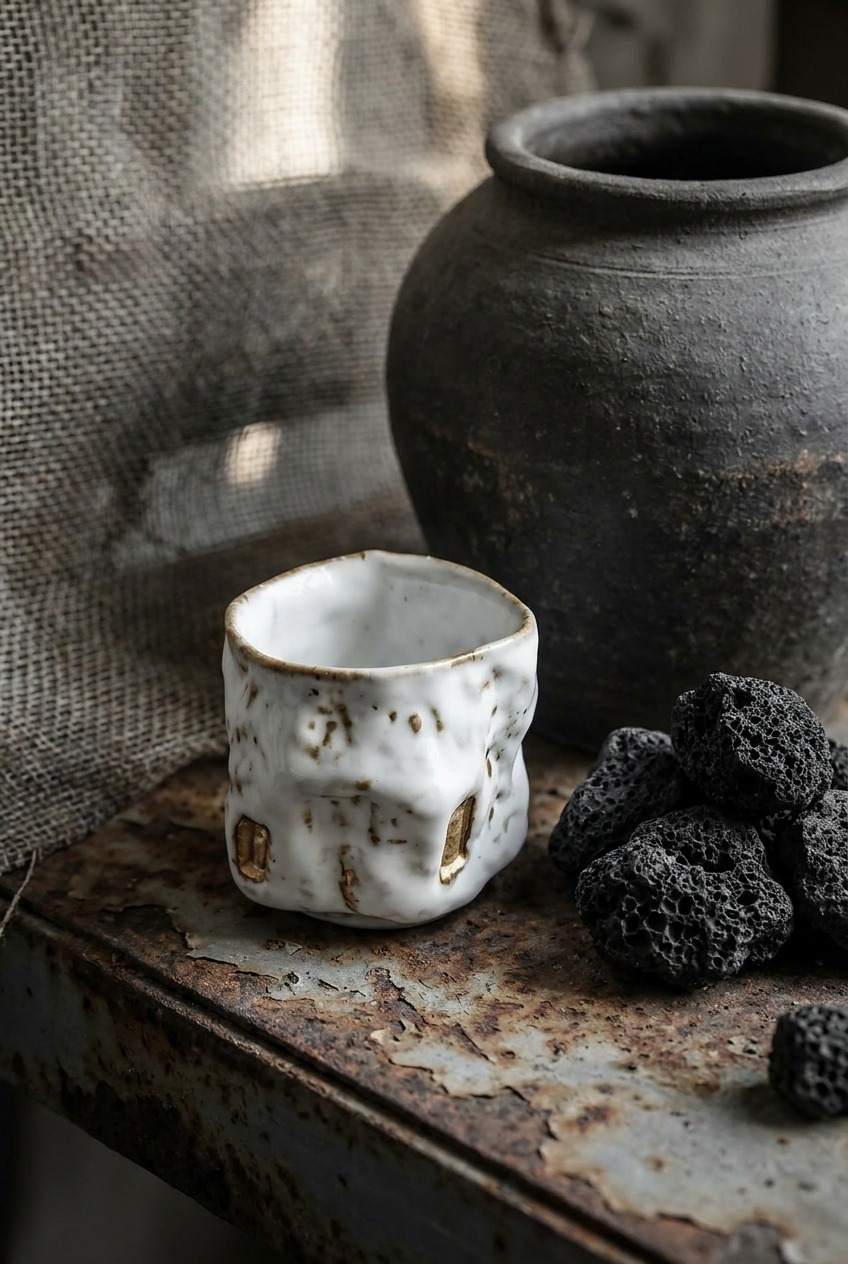
To discover this one-of-a-kind wabi sabi ceramics here
1. The Kiln as Co-Author
In conventional ceramic production — factory-made mugs, slip-cast tableware, electric kiln studio pieces — the maker controls the outcome. The glaze is tested for predictable colour. The firing temperature is held precisely. The atmosphere inside the kiln is oxidising, which is to say: chemically stable, fully supplied with oxygen, producing the colours the glaze was formulated to produce. The result is consistency. Every piece in the run looks like every other piece. This is the point.
In wood fired ceramics fired through reduction — which is to say, fired in an oxygen-starved atmosphere — consistency is structurally impossible. The kiln temperature fluctuates as wood is stoked. The atmosphere cycles between reduction and oxidation as fuel is consumed and oxygen enters. Ash from the burning wood travels through the kiln chamber and lands on the clay surfaces, melting into glaze where it settles. The position of each piece within the kiln — its distance from the firebox, its orientation relative to the flame path, the pieces beside it — determines what happens to its surface. The maker decides the clay body, the glaze composition, the firing curve, and the placement. The kiln decides the rest.
This division of authorship is not a limitation. It is the source of the specific beauty that wabi sabi ceramics represents: an object that carries in its surface the record of a real event — a specific firing, a specific atmosphere, specific conditions that existed once and will not exist again. As our guide to wood-fired pottery explains, the surface of a wood-fired piece is not decorated. It is written.
2. The Chemistry of the Unpredictable: Reduction, Oxidation, and Kiln Atmosphere
The same metal oxide, two different colours — depending on what the kiln atmosphere allows:
| Metal oxide |
Colour in oxidation |
Colour in reduction |
| Iron oxide |
Warm amber, rust |
Deep black, grey, metallic sheen |
| Copper oxide |
Green |
Red |
Understanding kiln atmosphere pottery requires understanding two chemical states that a kiln can inhabit: oxidation and reduction. The distinction between them is a question of oxygen availability, and it has dramatic consequences for how minerals in clay and glaze behave at high temperatures.
As the Ceramic Arts Network's technical analysis of kiln atmosphere explains, wood firing typically begins in oxidation as the kiln temperature rises carefully — oxygen is plentiful, combustion is efficient, the flame burns clean and blue. Once heavy stoking begins, the kiln is thrown into reduction: the fuel consumes all available oxygen, starving the atmosphere. In this oxygen-depleted state, something chemically significant happens. Carbon monoxide — produced by incomplete combustion — becomes chemically unstable at high temperatures and seeks oxygen atoms to become the more stable carbon dioxide. It finds those oxygen atoms in the metallic oxides present in the clay body and glaze: iron oxide, copper oxide, manganese oxide. The carbon monoxide strips oxygen from these compounds, leaving the metals in a chemically reduced state. The reduced metals are a different colour from their oxidised counterparts.
The practical consequences of this are what give reduction firing ceramics their characteristic visual range. Iron oxide (Fe₂O₃) in an oxidising atmosphere produces warm amber and rust tones. In reduction, the same iron compound becomes FeO — iron in a different oxidation state — producing the deep blacks, greys, and metallic sheens characteristic of tenmoku and oil-spot glazes. Copper oxide, which produces green in oxidation, can shift to copper red in reduction — one of the most sought-after and difficult-to-control effects in high-temperature ceramics. The specific colour produced depends on the exact moment in the firing, the exact depth of reduction, the specific concentration of the mineral in the glaze, and the specific temperature at that location in the kiln. How wood firing affects glaze is, in short, a story of chemistry made visible: the surface of the finished piece is a record of what happened to its minerals under those specific atmospheric conditions.
The atmosphere inside a wood kiln is never static. As Ceramic Arts Network's analysis of the reduction firing process notes, the kiln cycles between reduction, neutral, and oxidation atmospheres across the duration of the firing — sometimes within minutes, as stoking patterns change. This cycling is what produces the complex, layered surfaces of unpredictable glaze effects: a surface that has experienced oxidation, then reduction, then oxidation again shows the accumulated result of all three states. The maker can shape these cycles through technique and timing, but cannot fully script them. Each firing is an experiment with a known range of outcomes but no predetermined result.
3. Where the Clay Comes From: Dehua and Its Mineral Ground
The specific character of the glazes and surfaces produced in our pieces is inseparable from their origin. Every cup is made in Dehua, Fujian province — one of the most historically significant ceramic-producing regions on earth, with a documented production history stretching from the Song dynasty (960–1279 CE) to the present.
As Wikipedia's documentation of Dehua porcelain records, in 2021 the kilns of Dehua were inscribed on the UNESCO World Heritage List as part of the Quanzhou sites, recognised for their importance to medieval maritime trade and the global exchange of cultures. Over 180 kiln sites have been identified in the region, spanning from the Song period to the present. The Dehua ceramic tradition is one of continuous production across more than a millennium — a tradition in which the relationship between local mineral resources, kiln technique, and finished surface has been understood and refined across hundreds of generations of makers.
Compositional analysis of Dehua ceramics published in ScienceDirect confirms that the geological differences between sub-regions within Dehua produce measurably distinct ceramic compositions — that the mineral content of the clay mined in different parts of the county produces different chemical behaviour in the kiln, different surface characteristics in the finished piece. The Daiyun mountain range that forms the geological backdrop of Dehua is rich in kaolin, feldspar, quartz, and iron-bearing minerals — the specific combination that makes the region's clay bodies so responsive to high-temperature firing and atmospheric variation. As our guide to rock-mineral clay explains, the mineral-rich clay of Dehua is not merely a raw material — it is the primary contributor to the visual character of every piece it produces. The surface you see is the soil, transformed.
4. The Five Glazes: What Each Surface Is and How It Forms
Each piece in the Eartivo collection uses a distinct glaze or surface treatment, each of which interacts with the Dehua mineral clay body and the kiln atmosphere in a specific way. Understanding what each glaze is — what minerals it contains, how those minerals respond to reduction firing — explains why each collection piece has a completely different visual character, and why no two pieces within a collection are identical.
A quick overview of the five glazes and what makes each one distinct:
| Product |
Glaze type (English) |
Characteristic colours |
| The Moonlit Grotto |
Natural mineral stone glaze |
Cool grey-green to deep blue-black |
| The Resilient Gold |
Natural mineral stone glaze |
Warm white to gold-amber |
| The Stone Sanctuary |
Mineral glaze |
Deep brown, ochre, metallic sheen |
| The Duality Insight |
Kiln transformation glaze |
Silver-white contrasted with deep black |
| The Abstract Ascent |
Natural ash glaze |
Warm red and amber tones |
The Moonlit Grotto & The Resilient Gold — Natural Mineral Stone Glaze
Natural mineral stone glaze is formulated from raw mineral materials — stone powders, mineral oxides, and natural flux materials ground and suspended in a glaze base — rather than from commercially processed ceramic stains. The specific minerals used determine both the glaze's base colour and its response to atmospheric variation in the kiln. Because the raw minerals are not chemically purified, they contain trace elements and impurities that contribute to surface complexity and unpredictability: the same glaze batch applied to two different pieces in different positions within the kiln will produce surfaces that differ in colour depth, surface texture, and the specific way pooling and breaking have occurred.
In The Moonlit Grotto, the natural mineral stone glaze produces the characteristic cool grey-green and blue-grey tones that shift across the surface depending on glaze thickness — thinner areas breaking lighter, pooled areas deepening toward blue-black.
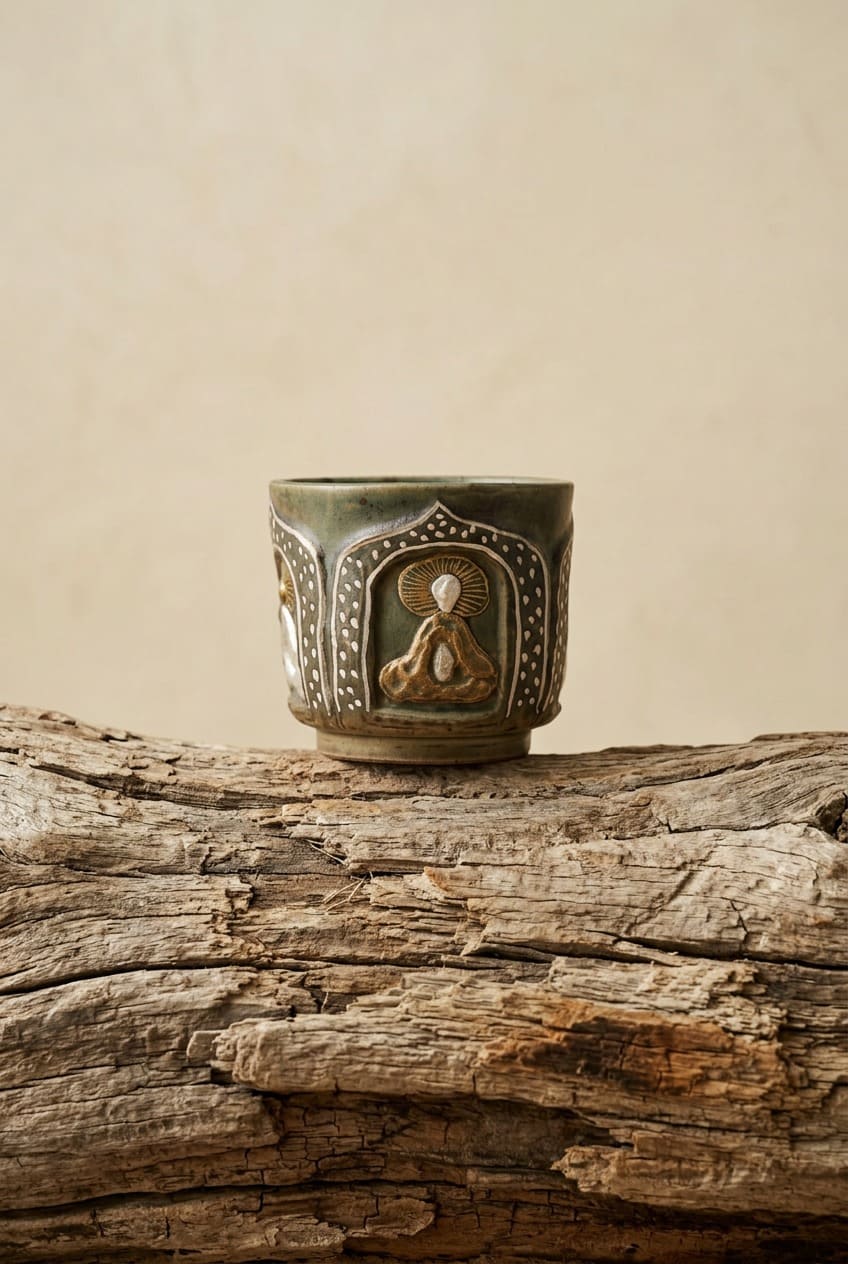
The Moonlit Grotto — A handcrafted wood fired ceramic cup with earthy brown glaze and rugged, grotto-like texture. The wood firing process infuses its surface with subtle sheen and natural variations, showcasing how wood firing transforms glaze into a story of heat, smoke, and artisanal nuance.
In The Resilient Gold, the same category of natural mineral glaze produces the warm white and gold-amber tones that result from the specific iron and mineral content of that glaze formulation responding to the kiln atmosphere. Both pieces are organic pottery in the most material sense: their surface colour comes from minerals, not from synthetic stains, and those minerals behave differently under slightly different conditions each time.
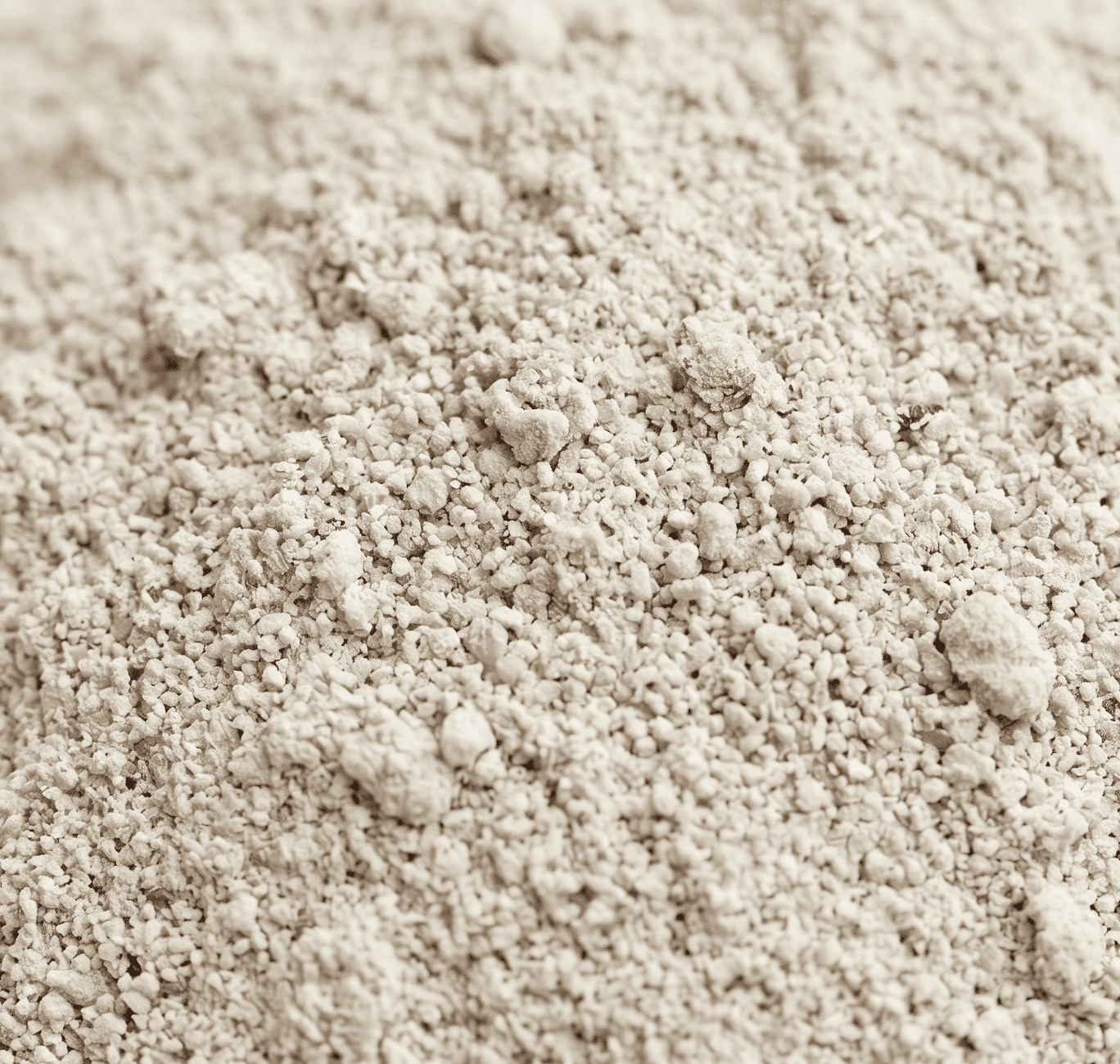
The Resilient Gold handmade ceramic cup with warm white natural mineral stone glaze — mineral-rich clay surface showing kiln atmosphere effects and organic pottery texture
The Stone Sanctuary — Mineral Glaze
The Stone Sanctuary: deep brown and ochre tones with a metallic sheen at certain angles — iron in its reduced state, written into the glaze surface. The rough exterior is not the glaze alone but the mineral clay body showing through it.
The rough, granular texture of The Stone Sanctuary's exterior is not the glaze alone — it is the interaction between the glaze and the rock-mineral clay body beneath it. The quartz and mica particles in the clay that did not melt at firing temperature protrude through or beneath the glaze layer, creating the coarse-grained surface that is the defining tactile quality of this piece. This is the wabi sabi ceramics aesthetic at its most literal: the surface is a geological event, not a design decision.
The Duality Insight — Kiln Transformation Glaze
The Duality Insight uses what is explicitly called a kiln transformation glaze — a glaze formulated specifically to produce dramatic and unpredictable surface variation in response to atmospheric changes during firing. Kiln transformation glazes typically combine multiple metal oxide colourants — iron, copper, titanium, manganese — in a base that flows and moves at high temperature. As the kiln atmosphere cycles between reduction and oxidation, each metal oxide in the glaze shifts its colour state independently, and the flowing glaze carries different concentrations of these compounds to different areas of the surface as it moves.
The result on The Duality Insight is the characteristic dual-surface that gives the piece its name: the dramatic contrast between the silver-white areas (where the glaze broke thin over the clay body's relief) and the deep black or metallic dark areas (where iron in reduction produced its darkest expression, and where pooled glaze concentrated the colourants). Unpredictable glaze is not a quality issue in this context — it is the mechanism. The specific distribution of silver and dark on any given piece of The Duality Insight is the direct record of how that piece's glaze moved during that firing. It cannot be pre-designed, and it cannot be reproduced.
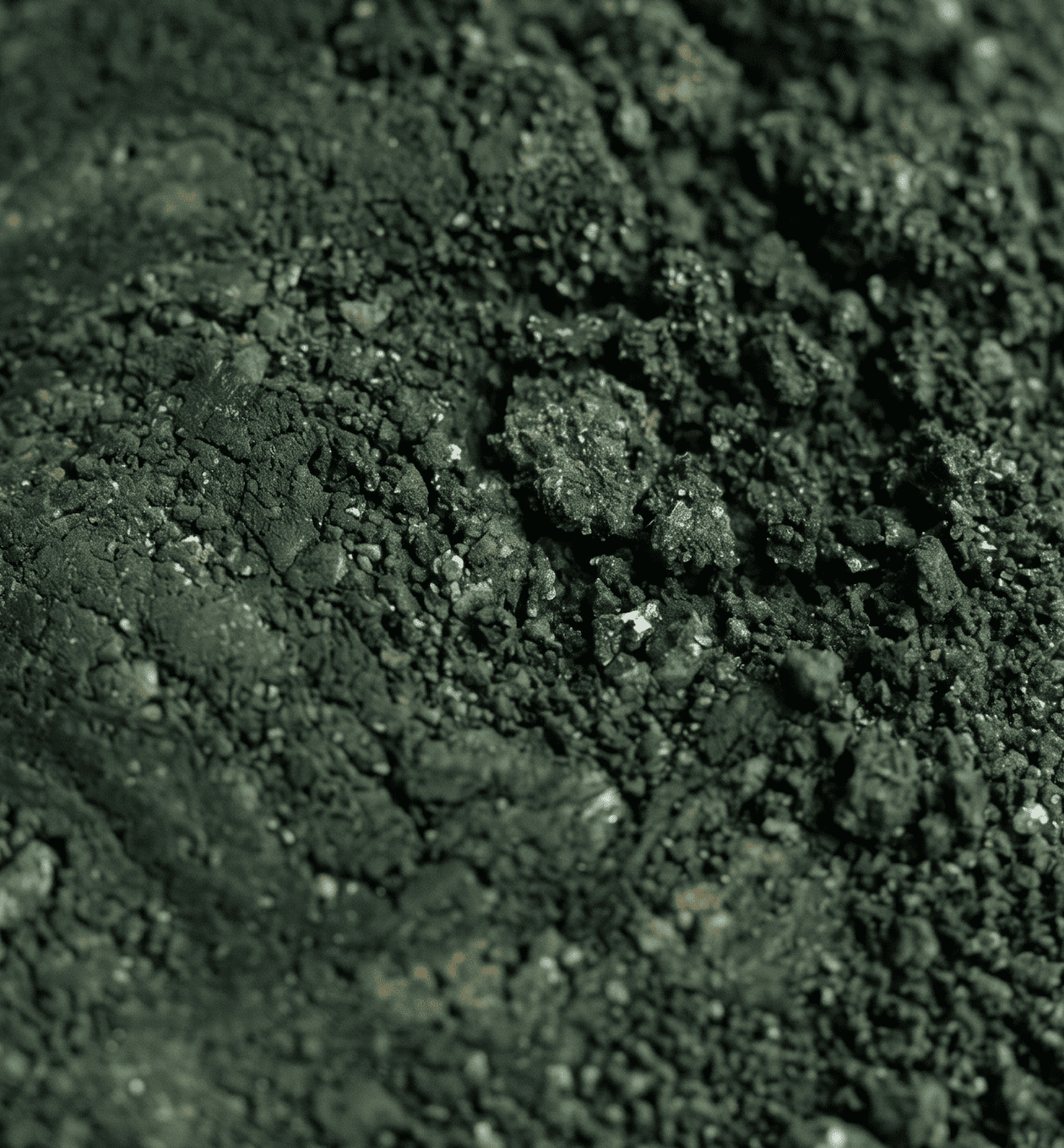 The Duality Insight: the kiln transformation glaze that gives this piece its name. Silver-white where the glaze broke thin, deep black where iron reached its darkest expression in reduction. The specific distribution on this piece happened once, in one firing, and will not happen again.
The Abstract Ascent — Natural Glaze
The Abstract Ascent uses a natural glaze — a term that, in the Dehua tradition, specifically refers to glazes made from locally sourced raw materials including wood ash, mineral stone powders, and naturally occurring clay slips, without synthetic or commercially processed colourants. Natural ash glazes are among the oldest glaze types in East Asian ceramic history: the practice of collecting and using the ash produced by the kiln's own wood fuel as a glaze material connects the firing process to the surface outcome in the most direct way possible. The glaze is made from the same fire that fires the piece.
5. Perfectly Imperfect: The Aesthetic Philosophy Behind the Science
The phrase perfectly imperfect is the contemporary Western shorthand for what the Japanese aesthetic tradition calls wabi-sabi: the recognition that imperfection, incompleteness, and the visible marks of natural process are sources of beauty rather than evidence of failure. In ceramics, this philosophy has a specific material grounding.
The perfectly imperfect pottery piece is not imperfect because it failed to meet a standard — it is perfectly imperfect because its imperfections are the direct expression of the materials and processes that made it. The asymmetry was not a mistake; it was the clay responding to the hand. The colour variation was not an error; it was the minerals responding to the atmosphere.
This is a fundamentally different theory of value from the one that governs mass production. Industrial production measures quality by the absence of variation — every piece identical, every deviation corrected or rejected. Wabi sabi ceramics measures quality by the presence of honest variation — every piece carrying the specific record of its making, every deviation the evidence of real materials under real conditions. Neither theory is wrong. They are answers to different questions. Industrial production asks: how consistently can we meet a specification? Wabi sabi ceramics asks: what is the most honest and specific surface this material and this process can produce? The answer to the second question is always unrepeatable. As our guide to the wabi-sabi aesthetic and material honesty explores, the objects that carry the most convincing presence are those that do not conceal what they are made of or how they were made.
The philosophical significance of the kiln transformation aesthetic goes beyond aesthetics into something closer to ethics: a commitment to letting the material be what it is, and letting the process be what it is, without imposing a predetermined outcome. Why is each pottery piece unique is not just a question about surface variation — it is a question about what kind of making produced it. Pieces made with the intention of controlling every variable produce surfaces that look controlled. Pieces made with the intention of creating the conditions for something real to happen — and then witnessing what happens — produce surfaces that look alive.
6. Why Factory Production Cannot Replicate This
The surfaces described in this article are not difficult to replicate because the equipment is hard to access or the skill is rare. They are impossible to replicate in factory production because the processes that produce them are structurally incompatible with factory production logic. How wood firing affects glaze depends on a specific kiln, a specific batch of wood, a specific day's atmospheric conditions, a specific placement of each piece, a specific firing curve managed by experienced hands. None of these variables can be standardised across a production run. The attempt to standardise them produces a different kind of piece entirely.
Electric kiln firing — the basis of almost all industrial ceramic production — fires in oxidation, not reduction. As DigitalFire's technical reference on oxidation firing explains, oxidation atmospheres produce bright, fully expressed glaze colours as formulated — the intended colour of the glaze without atmospheric modification. This is ideal for production consistency. What it cannot produce is the specific visual vocabulary of reduction: the iron blacks, the copper reds, the carbon trapping, the fire marks, the unpredictable surface variation that comes from a kiln atmosphere that is never fully stable. The difference between handmade and factory-made ceramics is therefore not only a question of forming method but of firing method: the two together determine not just the shape of the piece but the entire character of its surface.
This is also organic pottery in the sense the word was always meant: made from organic materials (clay, mineral glazes, wood ash, wood fuel), shaped by organic forces (human hands, fire, atmospheric chemistry), and marked by organic variation (the specific record of this firing, this placement, this clay batch). The alternative — the factory piece, the electric-kiln piece, the consistent production run — is a legitimate choice for different purposes. But it produces a different kind of object. What it cannot produce is this: a surface that is the direct record of something that happened, once, unreproducibly, in a specific kiln in Dehua.
7. Frequently Asked Questions
Why is each pottery piece unique in wood-fired reduction ceramics?
Because the specific colour, texture, and surface variation of each piece is determined by conditions — kiln atmosphere, temperature fluctuation, ash deposition, piece placement — that vary within every firing and cannot be reproduced identically between firings. The glaze is formulated to respond to these conditions, not to resist them. The result is that even two pieces made from the same clay, with the same glaze, placed in adjacent positions in the same firing, will look different: one received slightly more reduction at the critical temperature moment, one had ash settle on its shoulder, one was fractionally closer to the flame path. These differences are not errors. They are the specific record of what happened to each individual piece.
What makes wabi sabi ceramics different from other handmade pottery?
All handmade pottery differs from factory production in forming method. Wabi sabi ceramics specifically refers to pottery made within an aesthetic tradition that values the visible marks of natural process — kiln atmosphere effects, mineral surface texture, glaze variation, fire marks — as intrinsic to the piece's beauty rather than as departures from a standard to be corrected. The making decisions (choice of clay body, glaze composition, firing method) are oriented toward creating conditions in which these natural processes can express themselves most fully, rather than toward controlling them into a predetermined outcome. The philosophical commitment is to material honesty: the finished piece shows what the materials are and what the process was, without concealment.
Reduction firing ceramics — is the process safe for food use?
Yes. The reduction atmosphere exists inside the kiln during firing — it is a firing technique, not a property of the finished piece. Once the piece has been fired and cooled, the clay body and glaze are stable, chemically inert, and food-safe, provided the glaze materials themselves are non-toxic and properly fired to maturity. All pieces in the Eartivo collection use natural mineral glazes that have been tested to food safety standards across multiple countries and regions. The firing atmosphere affects the visual character of the glaze, not its food safety.
A Final Note
The specific beauty of a wabi sabi ceramics piece fired in reduction is not the beauty of the designed, the controlled, or the perfected. It is the beauty of the witnessed: the record of what the minerals, the fire, and the atmosphere created together, on this specific day, in this specific kiln, in this specific geological and cultural landscape that has been producing ceramics since the Song dynasty. When you hold one of these cups, you are holding the evidence of that event. The perfectly imperfect surface — the fire marks, the mineral protrusions, the glaze that moved where the heat was strongest — is not a compromise. It is the point. It is the only surface that tells the truth about how it was made.
Related Articles
References


