Contents
Most people who start a journal stop within a few weeks. This isn't a failure of willpower — it shows up consistently enough in research on habit formation and expressive writing that it's worth asking a more useful question: not "how do I try harder", but "what's actually missing from how most people set this up?"
One answer, often overlooked, is structure outside the page itself. An intention setting journal tends to work better — and last longer — when it's paired with something consistent: the same time, the same quiet five minutes, and very often, an object that signals it's time to begin. This article looks at what the research on expressive writing actually shows, and at the practical role a fixed object can play in making the practice stick.

1. Why Most Journaling Habits Don't Last
Most people who start journaling do it the same way most people start any new habit: with enthusiasm, no fixed structure, and an assumption that motivation alone will carry it forward. Within a few weeks, the same friction that ends most new habits sets in — there's no specific time, no specific cue, and the practice quietly competes with everything else demanding five minutes of attention.
Our guide to tea meditation covers a related problem from a different angle: practices that depend purely on remembering to do them tend to fade, while practices anchored to something physical and repeated tend to survive. Journaling has the same vulnerability — and the same potential fix.

2. What the Research Actually Shows
The foundational research here comes from psychologist James Pennebaker, whose 1986 study found that writing about emotionally significant experiences for just fifteen to twenty minutes, across three to four consecutive days, produced measurable improvements in both psychological and physical health markers. A 2006 meta-analysis pooling dozens of subsequent studies confirmed the effect held up: expressive writing about difficult or meaningful experiences is associated with reduced psychological distress and improved physical health outcomes.
What's less widely known is that the effect has also proven inconsistent across studies — some replications find a strong benefit, others find very little. A 2023 study in Frontiers in Psychology investigated why, and found that the degree to which someone genuinely engages with the writing — rather than going through the motions — is one of the strongest predictors of whether the practice produces any benefit at all. Engagement, not just the act of writing, is what makes the difference.
This finding matters more than it might first appear. It suggests that the central challenge of intention journaling isn't finding the right prompts — it's finding a way to show up with genuine attention, consistently, rather than rushing through a few sentences out of obligation.
3. The Missing Piece: Why an Anchor Object Helps
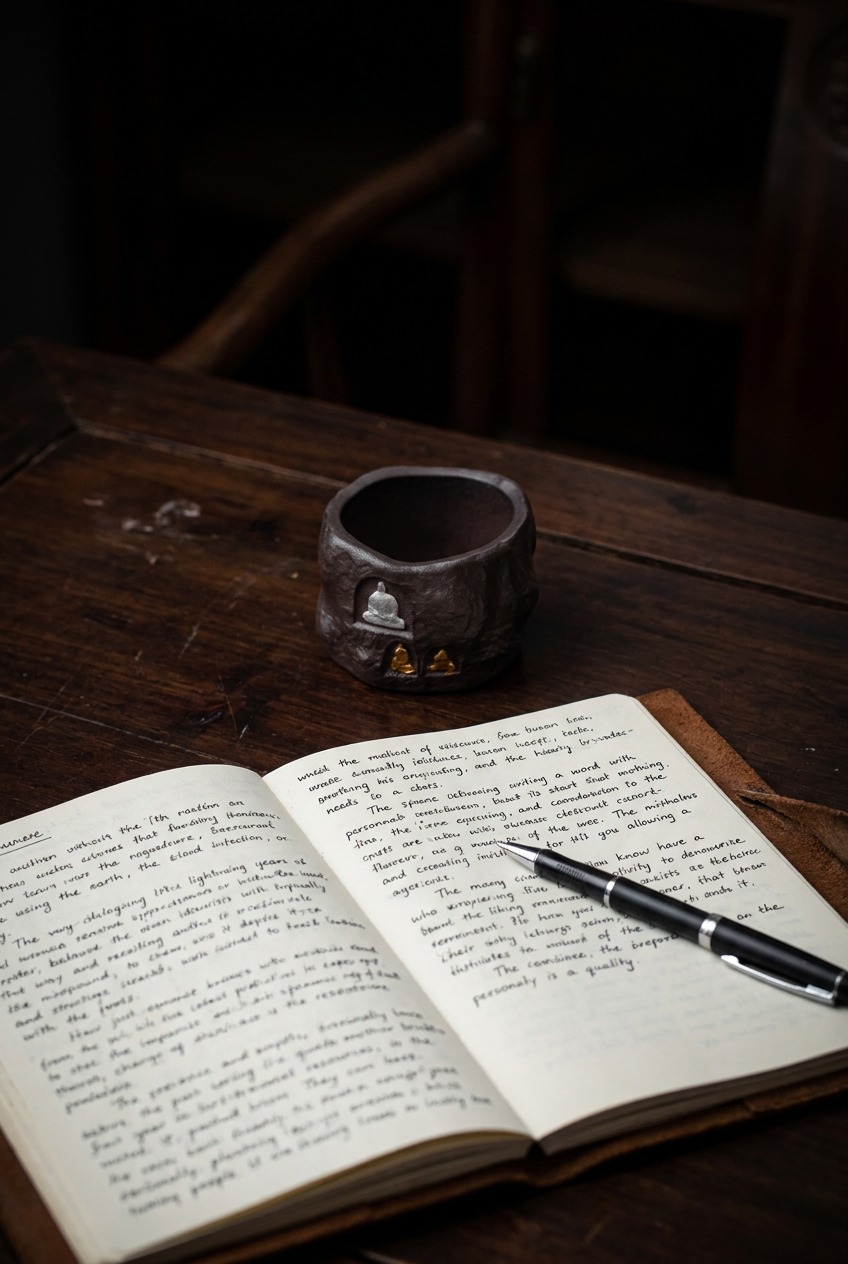
This is where a fixed object earns its place in the practice. Our guide to the morning ritual explores how a consistent object — picked up the same way, at the same point in the day — becomes a cue that signals a particular state of mind is about to begin. Applied to journaling, the same mechanism works in a specific, practical way: a cup of tea, made and held during the few minutes before writing, gives the mind something to settle into before the pen touches paper. The transition from "scattered" to "ready to write with attention" doesn't have to happen on the page itself — it can happen in the few minutes before, with the cup as the marker.
There is also a slower effect worth naming. Our guide to the wabi-sabi sanctuary describes the 90% rule — a handmade object leaves the kiln roughly 90% complete, with the remaining 10% developing through use. A cup used specifically and only for this practice, day after day, begins to carry a quiet association with it — not because of anything mystical about the object, but because consistent pairing is exactly the kind of repetition that builds an association in the first place.
4. A Simple Starting Structure
For anyone looking for journal prompts for intention setting, the temptation is to find an elaborate list. In practice, three short, consistent prompts — used every time — tend to work better than dozens of options, precisely because consistency is what builds the habit in the first place.
What I'm carrying in
One or two sentences on whatever state of mind is present — no editing, no "should." This is closest to Pennebaker's original protocol: naming what's actually there, without softening it.
What I intend for today
Not a to-do list — a single sentence about the quality of attention or energy intended for the day. "Patience" or "follow-through" works as well as a paragraph.
One thing I'm setting down
A specific worry, task, or thought that doesn't need to be carried into the rest of the day. Naming it on paper is often enough to loosen its grip, even without resolving it.
Three prompts, every time:
|
Prompt
|
Purpose
|
|
What I'm carrying in
|
Names the current state of mind without editing or judgment
|
|
What I intend for today
|
One word or sentence — quality of attention, not a to-do list
|
|
One thing I'm setting down
|
A specific worry or thought released onto the page, not carried forward
|
5. Pairing the Journal With a Ritual, Not Just a Habit

A journal kept purely as a task — something to check off — rarely survives long. A journal embedded in a small ritual, with a consistent object and a consistent few minutes around it, has a better chance, for the same reason moon water rituals work: a stated intention, paired with a deliberate physical action, gives the mind something concrete to organize around.
For anyone who already pairs a few slow breaths with tea, adding journaling afterward — rather than before — often works best: a settled body tends to produce more honest, less rushed writing than a racing one. The order matters less than the consistency, but most people find breath, then cup, then page, to be a natural sequence.
6. Frequently Asked Questions
What's the simplest way to figure out how to start journaling if I've tried before and stopped?
Start smaller than feels necessary — the three-prompt structure in Section 4 can be completed in under five minutes, which removes the most common reason people quit: the sense that journaling requires more time and energy than they actually have most days. Pairing it with an existing habit, like morning tea, removes the need to remember on its own.
Does intention journaling need to happen in the morning?
No — the research in Section 2 doesn't specify a time of day, and the mechanism (engagement, not timing) is what matters most. Morning tends to work well because it sets a tone before the day's demands begin, but an evening practice, paired with a different consistent ritual, works through the same mechanism.
What if I don't know what to write for an intention setting journal?
This is precisely what the three-prompt structure in Section 4 is designed to solve — having the same three questions every time removes the blank-page problem entirely. The content changes daily; the structure doesn't need to.
A Final Note
An intention setting journal rarely fails because of the wrong prompts. It fails because nothing in the surrounding day signals that this is the moment to slow down and actually mean what gets written. A cup, held the same way each time, before the pen ever touches the page, can be exactly that signal — small enough to be sustainable, consistent enough to be trusted.
References
Related Articles


