Contents
Most guides to breathwork treat it as a stand-alone practice — something done on a mat, eyes closed, separate from the rest of the day. But breath doesn't need its own dedicated session to matter. A handful of slow breaths, taken in the thirty seconds before the kettle finishes boiling, does real, measurable work — and pairs naturally with almost any ritual already built around stillness.
This article looks at what the research actually shows about slow breathing, and at one of the simplest ways to use it: not as a separate practice to add to an already full day, but as the few seconds that come right before the first sip of tea.
1. Why Breath Comes Before the Cup
Many people arrive at breathwork for beginners content looking for something elaborate — a 20-minute guided session, a specific app, a class. But the research on slow breathing doesn't require any of that. The effect comes from the breathing rate itself, sustained for even a short period, not from the elaborateness of the practice around it.
This is the same principle our guide to tea meditation explores from a different angle: a small, repeated physical action — held with attention — can shift the nervous system before any "technique" in the traditional sense comes into play. A few slow breaths before the first sip is one of the simplest possible versions of this.
2. What Slow Breathing Actually Does
The research on this is more substantial than most wellness claims. A 2022 systematic review and meta-analysis published in Psychoneuroendocrinology (via ScienceDirect), pooling data across dozens of studies, found that voluntary slow breathing produces a consistent, measurable increase in heart rate variability (HRV) — specifically the component of HRV linked to parasympathetic, or "rest and digest," nervous system activity. This effect was observed during the breathing itself and continued for a period afterward.
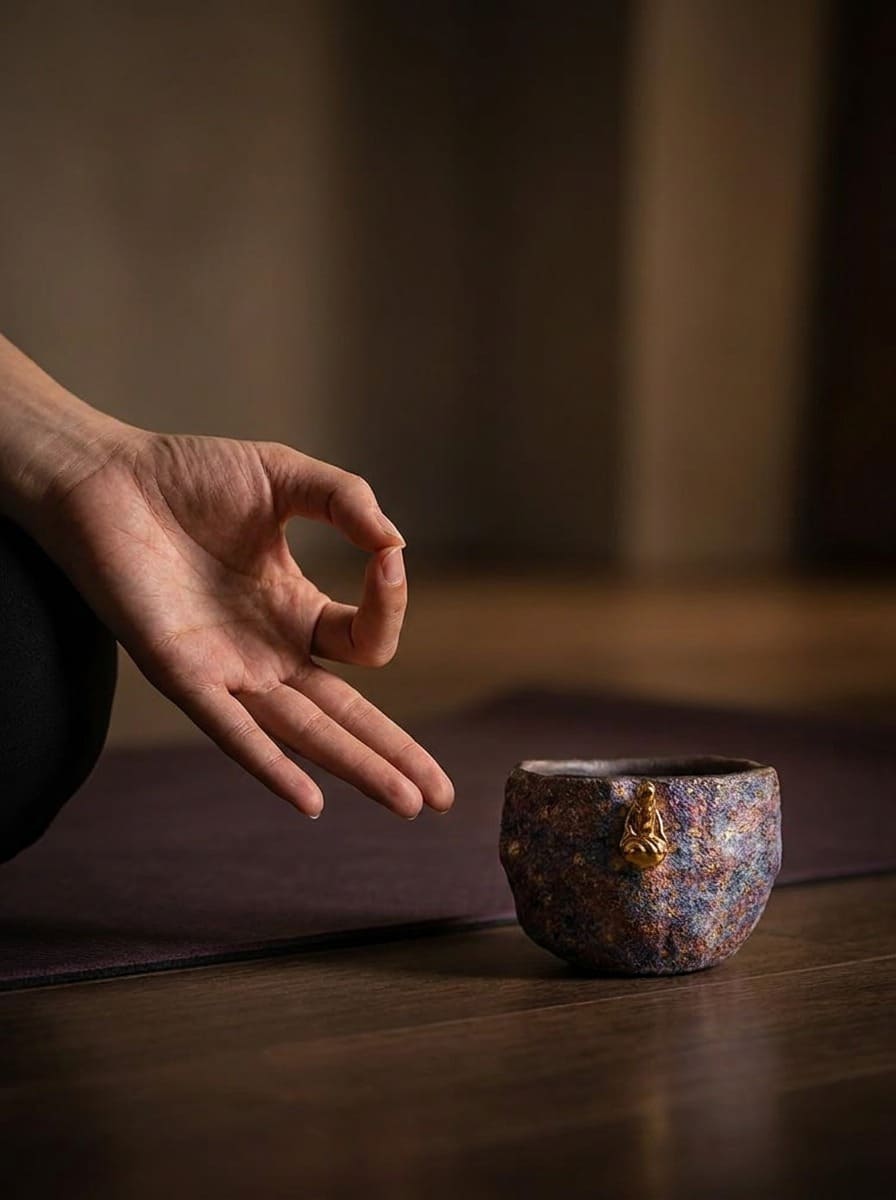
This isn't a small or speculative finding. HRV is one of the most widely used physiological markers of stress resilience and autonomic regulation in clinical research — and the meta-analysis found the effect to be consistent enough to qualify as one of the better-evidenced calming techniques studied to date.
3. The Vagus Nerve: The Mechanism Behind the Calm
The "why" behind this effect runs through the vagus nerve — the longest cranial nerve in the body and the primary channel of the parasympathetic nervous system. Research published in Frontiers in Human Neuroscience describes what researchers call the "respiratory vagal stimulation model": slow, deliberate breathing increases vagal tone, which in turn shifts the body's overall balance away from sympathetic ("fight or flight") activation and toward parasympathetic activity.
A more recent review in the clinical literature summarizes the practical upshot plainly: slowing the breath is one of the few voluntary actions a person can take that directly and reliably influences an otherwise automatic nervous system process. Most of what the autonomic nervous system does — heart rate, digestion, immune signaling — happens outside conscious control. Breath rate is one of the rare exceptions, which is part of why it has become such a consistent focus across very different contemplative traditions.
4. Three Simple Techniques to Try
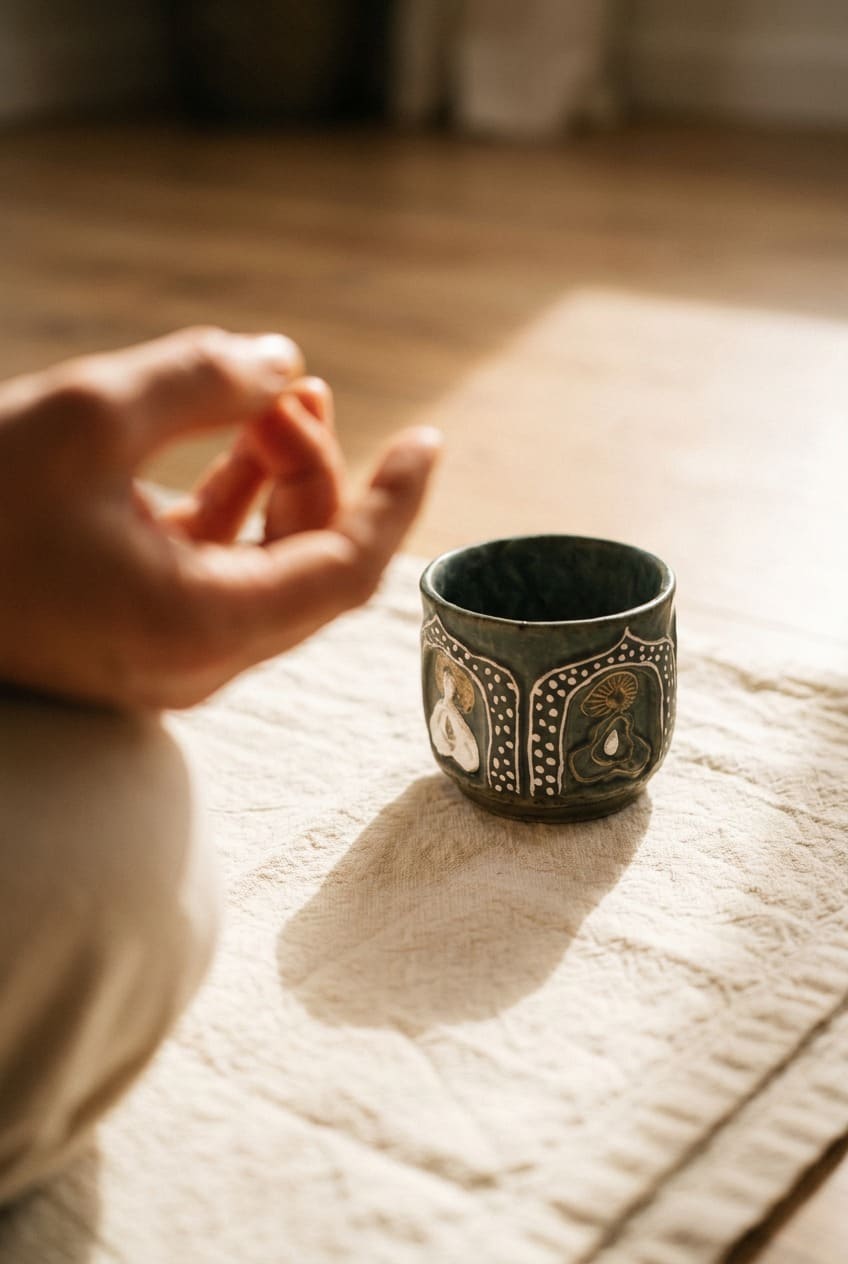
A recurring number across this research is six breaths per minute — roughly one breath every ten seconds — which several studies have used as a standard "slow breathing" protocol. None of the techniques below require equipment or training, and all can be done in under a minute.
Simple slow breathing
Inhale for a count of four, exhale for a count of six. The longer exhale relative to the inhale is what most research protocols use, since extended exhalation appears to drive a larger share of the parasympathetic effect.
Box breathing technique
Inhale for four counts, hold for four, exhale for four, hold for four. Popularized in military and first-responder training for its simplicity under stress, box breathing gives the mind a structure to follow, which some people find easier to sustain than open-ended slow breathing.
Extended exhale
No counting required — simply make each exhale noticeably longer than the inhale, breathing through the nose if possible. This is the least structured of the three, and works well as a thirty-second practice rather than a dedicated session.
Three techniques, side by side:
|
Technique
|
Pattern
|
Best for
|
|
Simple slow breathing
|
Inhale 4 / Exhale 6
|
A gentle starting point, no counting pressure
|
|
Box breathing
|
Inhale 4 / Hold 4 / Exhale 4 / Hold 4
|
Structure-seekers; widely used under acute stress
|
|
Extended exhale
|
No counting — exhale longer than inhale
|
Quick, no-equipment use during any short pause
|
5. Pairing Breath With a Tea Ritual
None of the techniques above need a cup of tea to work — the physiological effect is the same either way. But pairing the two has a practical advantage: the wait while water heats, or while a cup steeps, is already a small pocket of unstructured time most people fill with a phone. It is, without requiring anything extra, exactly enough time for several slow breaths.
Our guide to the morning ritual explores how a consistent object — the same cup, picked up the same way each day — becomes a kind of cue that a particular state of mind is about to begin. Breath, paired with that same cup, adds a second layer to the same cue: by the time the tea is ready, the body has already had thirty to sixty seconds of measurably calmer breathing before the first sip.
This pairing isn't unique to tea — the same logic appears in moon water rituals, where a specific, repeated action gives a stated intention somewhere to land, and in cacao ceremony, where the cup is held through an extended period specifically to give the mind something steady to return to. Breath simply adds one more layer of structure to a ritual that, in most cases, already has the right shape for it.
6. Frequently Asked Questions
How long does breathwork and meditation need to last to have an effect?
The research reviewed in Section 2 found measurable HRV changes during sessions lasting only a few minutes, with effects persisting for a period afterward. This means a short practice — even the thirty to sixty seconds it takes for tea to steep — is long enough to register a real physiological shift, even if a longer session produces a more pronounced one.
Is breathwork before meditation necessary, or can it replace meditation entirely?
Neither — they serve overlapping but distinct purposes. Slow breathing has a more immediate, mechanical effect on the nervous system via the vagus nerve, while meditation more broadly trains attention itself. Many people use breathwork as a short on-ramp into a longer meditation or ritual practice, rather than as a substitute for it.
What's the simplest way to start with breathwork for beginners?
The extended exhale technique in Section 4 requires no counting, no app, and no dedicated time — it can be layered onto an existing pause in the day, such as the minute or two it takes for tea to brew. Starting there, rather than with a more structured technique, tends to be the easiest way to build the habit before adding more formal practices.
A Final Note
Breathwork doesn't require a studio, an app, or a block of free time most people don't have. The research points to something much smaller and more available: a handful of slow breaths, taken anywhere, change something real in the body within seconds. The wait for a kettle to boil has always been there. It just hasn't always been used for this.
Related Articles
References


