Who Is This Gift For?
Four kinds of people this gift tends to suit:
| Type of person |
What they value |
Why this gift fits |
| Values slowness |
Protects their quiet morning ritual |
An object that participates in the ritual, not just serves it |
| Spiritually curious, not religious |
Drawn to meaning without dogma |
Imagery that speaks to stillness — spiritual decor, not store-bought iconography |
| Already has everything |
Notices the difference between attractive and considered |
A handmade piece can't be stumbled upon by accident — it signals you looked |
| Drinks tea/coffee with intention |
Has strong opinions about their cup |
The vessel changes the experience itself, not incidental |
A handmade wood-fired ceramic cup is not for everyone — and that is part of what makes it a good gift for the right person. Among mindfulness gifts, it sits in a particular category: not a product that promotes relaxation, but an object that quietly requires it. The right person tends to share a few recognisable qualities.
The Person Who Values Slowness
They have a morning ritual. They take their coffee or tea seriously — not in a pretentious way, but in the sense that they treat those first quiet minutes of the day as something worth protecting. They would appreciate an object that participates in that ritual rather than merely serving it.
The Person Who Is Spiritually Curious but Not Religious
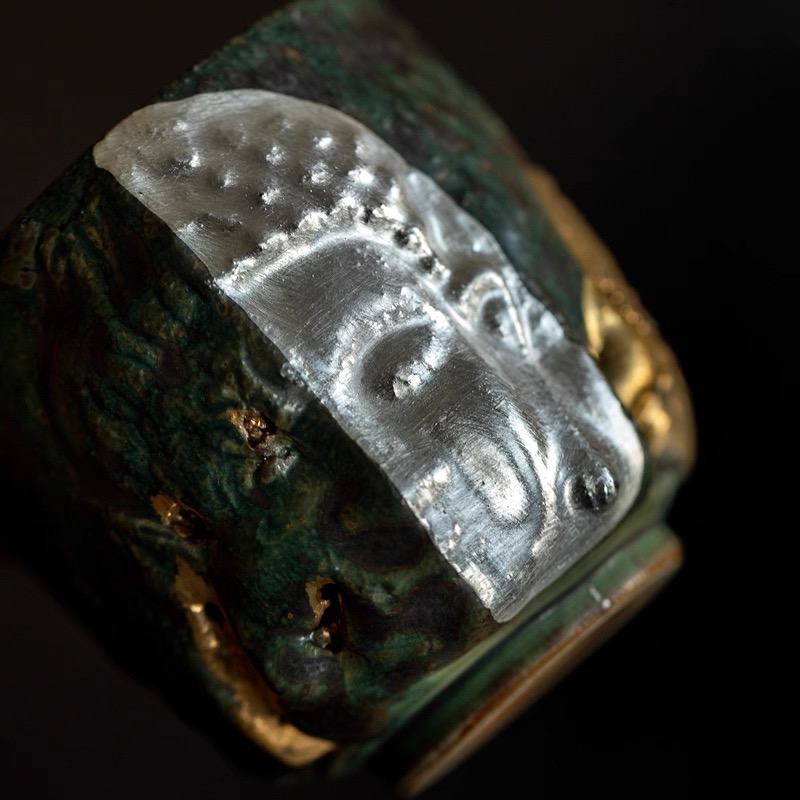
They may practise yoga, meditate occasionally, or simply hold a quiet belief that daily life can be approached with more intentionality. They are drawn to objects that carry meaning — not religious iconography in a devotional sense, but imagery that speaks to something larger than the everyday. This is spiritual decor in its truest sense: not a category in a home goods store, but a quality of object that holds space for the inner life. A seated figure in gold on a stone-like surface, for instance, says something about stillness without requiring any particular belief system.
The Person Who Already Has Everything
They are not easy to surprise. They buy what they want when they want it, and they have developed a sensitivity to the difference between things that are merely attractive and things that are genuinely considered. A handmade piece — one where no two are identical, where the fire had its say alongside the maker — is difficult to stumble upon by accident. It signals that you looked. (For a fuller guide to matching gifts with four specific personality types, see Buddha Statue and Beyond: Meaningful Gifts for 4 Types of Spiritual Seekers.)
The Person Who Drinks Tea or Coffee With Intention
They have strong opinions about their morning cup. They know the difference between water at 80°C and a full boil. They have experimented with different vessels and noticed — perhaps without being able to fully explain why — that what you drink from changes how the experience feels. For this person, the cup is not incidental. It is part of the thing itself.
Two Pieces Worth Knowing
The Resilient Gold — For the Person Who Finds Beauty in Imperfection
Fired in Shino — a clay body with ancient roots in Japanese ceramics — The Resilient Gold carries an irregular gold rim that follows the natural movement of the clay rather than any imposed geometry. Its surface is mottled with earth tones, punctuated by a small seated figure that seems less like decoration and more like a quiet presence. At 5 cm wide and 4 cm tall, it holds a single, considered measure — the size of something you drink slowly. It is a piece that rewards proximity: the closer you look, the more you find.
The Stone Sanctuary — For the Person Who Understands That Objects Can Hold Space
The Stone Sanctuary is made from rustic clay — a material rich in iron and mineral density, fired at high temperatures until it takes on the quality of something geological rather than manufactured. Its surface is intentionally uneven, its walls slightly irregular, its form somewhere between a vessel and a rock formation. Three small figures in silver and gold are set into its face — not symmetrically, not decoratively, but in the way that meaningful things tend to arrange themselves: without obvious logic, but with undeniable presence. This is a piece for someone who understands that a room can be changed by a single well-chosen object — the kind of zen home decor that earns its place by being genuinely worth looking at. (On how objects like this become more meaningful the longer they stay — Zen Home Decor That Lasts: Why Handmade Objects Become More Meaningful Over Time.)
On Giving Something That Cannot Be Googled
There is a quiet test for whether a gift is truly considered: could the recipient have found it themselves, easily, with a basic search? Most gifts fail this test. They are discoverable, comparable, and available in multiple options at varying price points. Peaceful home decor gifts, spiritual birthday sets, wellness bundles — the category is crowded with things that look considered but were not.
A wood-fired handmade ceramic cup — one that emerged from a specific kiln, on a specific day, shaped by hands that have spent years learning how fire and clay speak to each other — is not findable in that way. It exists because someone made it, and it came to you because you looked for something that could not be ordered next-day from a warehouse.
That is the difference between a gift and a purchase. And it is felt, even when it cannot be articulated.
The difference, in three questions:
|
Most gifts |
A handmade wood-fired cup |
| Discoverable |
Yes — searchable, comparable |
No — exists because someone made it, on a specific day, in a specific kiln |
| Available |
Multiple options, various price points |
One of a kind |
| What it says |
"I bought something" |
"I looked for something that couldn't be ordered next-day from a warehouse" |
Research on gift-giving backs this up empirically. A study examining handmade versus machine-made gifts, across three separate experiments, found that handmade gifts strengthen social relationships specifically because of their perceived uniqueness — the same mechanism the Google test above is pointing at. The effect held most strongly among recipients with higher social standing, suggesting that uniqueness becomes more valuable, not less, the more access someone already has to everything else.
FAQ
Are handmade ceramic cups safe to use for tea and coffee?
Yes. Food-safe handmade ceramics are fired at high temperatures that vitrify the clay body and, where glazed, create a non-porous surface safe for all hot and cold beverages. Unglazed or partially unglazed surfaces — common in rustic and wood-fired pieces — are also food-safe when fired correctly, and many tea drinkers prefer them for the subtle way the clay interacts with the liquid over time.
How do I care for a wood-fired ceramic cup?
Hand washing is recommended for handmade ceramics, particularly those with gold or metallic accents, which can be damaged by dishwasher detergents over time. For unglazed surfaces, avoid soaking in water for extended periods. With regular use and simple care, a well-made ceramic piece will last decades — and improve with age.
Is a handmade ceramic cup an appropriate gift for someone who doesn't drink tea?
Yes. While these cups are designed with tea and coffee in mind, their value is not limited to function. Many people display handmade ceramics as objects in their own right — on a desk, a shelf, or a windowsill — rather than using them daily. The piece has a life beyond the liquid it holds. As spiritual gifts for friends who value their space as much as their practice, an object that simply sits well in a room is already doing its work.
A Note on What a Gift Can Say
The best gifts are not the most expensive, or the most practical, or the most cleverly wrapped. They are the ones that communicate something true about how you see the person receiving them. The best mindfulness gifts go further still: they change something small about how the recipient moves through their day.
To give someone a handmade ceramic cup — something made slowly, fired unpredictably, and arrived at through skill and chance in equal measure — is to say: I think you are someone who appreciates things made with care. I think you notice the difference. I think you are worth a gift that cannot be easily replaced. As a meaningful housewarming gift for peaceful home, or as sympathy gifts for peace of mind during a difficult season, this kind of object carries weight that a bought-in-a-hurry present never does.
Most people are. Most gifts don't say so.
Related Articles:


