Contents
Some days reorganise themselves without your permission. The rain arrives, the pace drops, and suddenly the question is not what to accomplish but how to spend the next few hours well. For many people, this is when cozy home decor stops being an abstract concept and becomes something urgent and practical: what does this space need to feel like a place you want to be in?
The answer is rarely more furniture or a new colour on the wall. It is almost always something smaller — a change in light, a familiar ritual, an object worth holding. On a rainy day, the right cup of tea is not a minor comfort. It is the thing that turns a grey afternoon into something worth remembering.
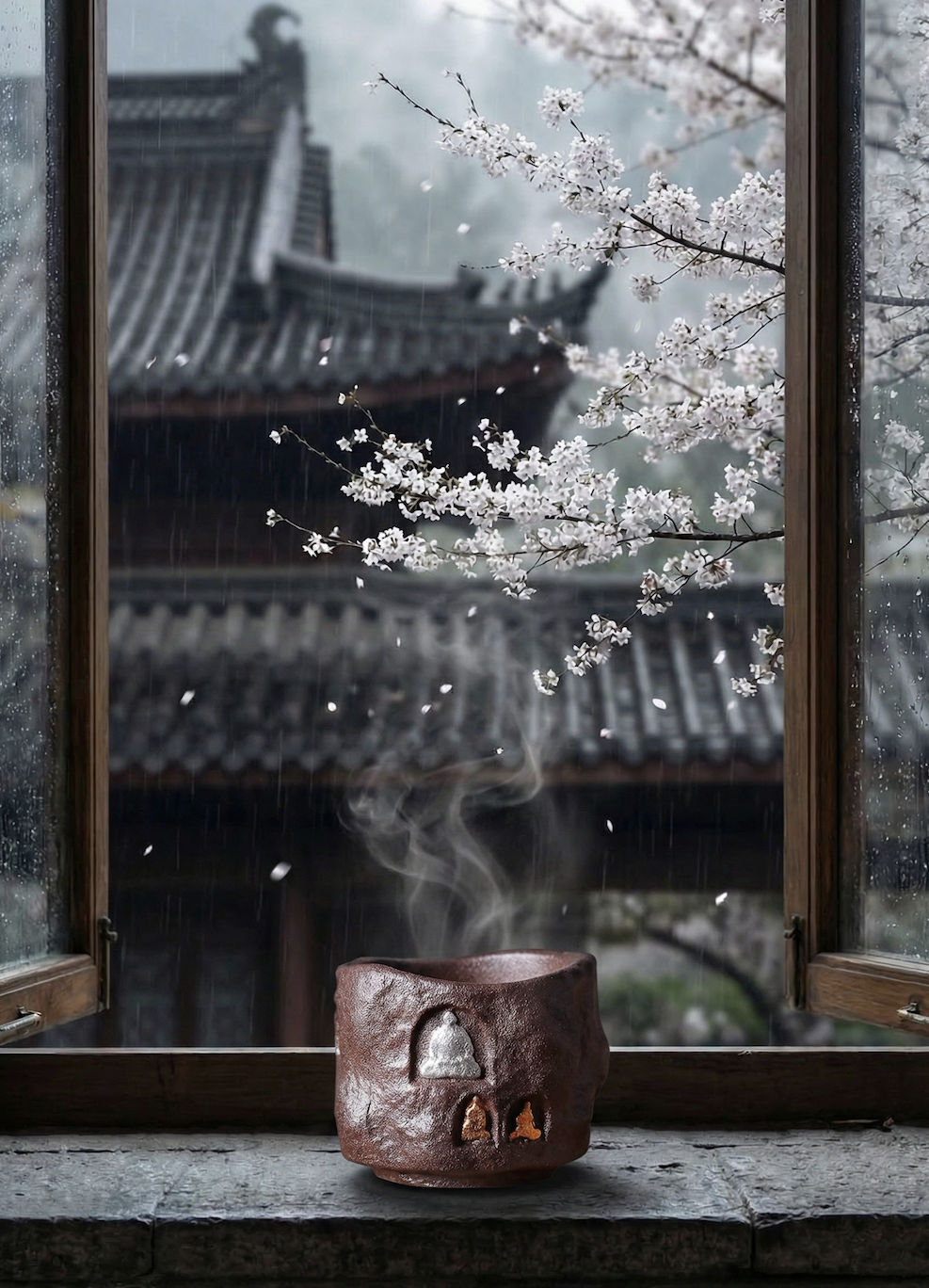
1. What Rain Actually Does to Your Brain
Before we talk about interiors and rituals, it helps to understand what rain is actually doing to your nervous system. The sound of rainfall sits at around 40 to 50 decibels — a range that research consistently identifies as ideal for sustained attention. Loud enough to mask the intermittent sounds that fracture concentration, gentle enough not to compete with thought. Your brain is not passively tolerating the rain. It is, in a measurable sense, helped by it.
There is also a rhythm dimension. Rain is what neuroscientists call a pink noise source — a sound with more energy at lower frequencies, softer and more soothing than pure white noise. The consistent pattern of rainfall tells the brain's threat-detection system that there is nothing to monitor, no sudden sounds to parse. The result is a state of relaxed alertness: awake, present, but not scanning. It is precisely the state in which mindful living becomes easy rather than effortful — not because you have tried to be mindful, but because the environment has done part of the work for you.
This is not coincidence. Humans evolved outdoors. Our nervous systems are calibrated to natural sounds, and steady rain is one of the most ancient signals of safety and shelter — the kind of weather that meant, for most of human history, that you were inside, protected, and had nowhere urgent to be. The sense of permission to slow down that comes with rain is not nostalgia. It is neurology.
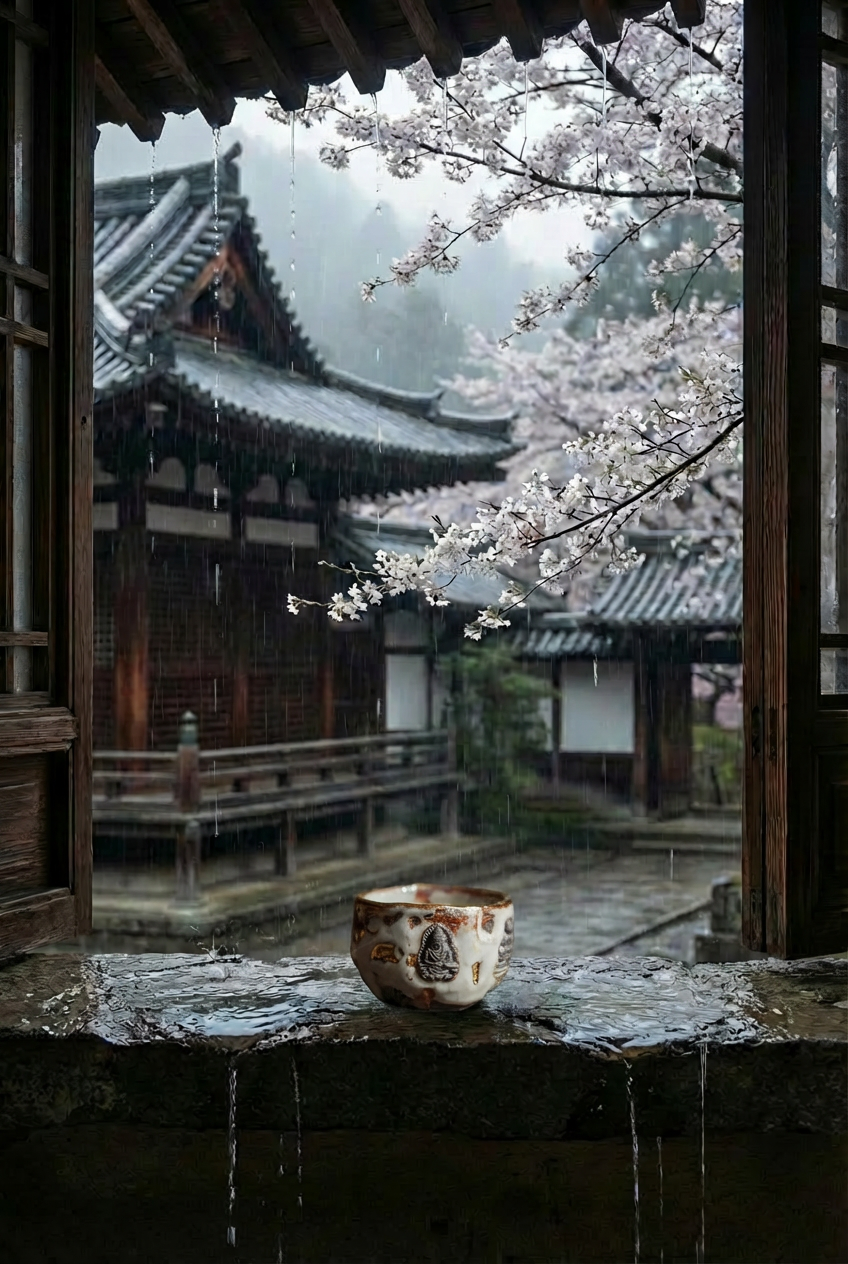
Rain on stone, cherry blossoms past the frame, a handmade cup at the edge of shelter and open air. This is what a rainy day tea ritual actually looks like — not styled, not arranged, just the right object in the right moment, while the season does what it does outside.
2. Why Cozy Home Decor Starts with What You Hold, Not What You Hang
The conversation about cozy home decor tends to focus on the visual: warm colours, soft textures, the right lamp. These things matter, but they address a room's atmosphere rather than your experience of it. The most direct route to feeling at ease in a space is tactile — what you are touching, what temperature you are feeling in your hands, what you are holding.
A handmade ceramic cup operates on this level in a way that almost nothing else does. Its weight is immediate. Its surface — whether smooth or textured, whether the glaze has moved or pooled or caught fire-marks in the kiln — gives the hands something specific to register. And it holds heat in a particular way: not the thin warmth of a paper cup or the uniform, cooling warmth of mass-produced porcelain, but the dense, steady retention of a vessel with real clay walls that took time to make and time to fire.
This is not sentimentality. It is a description of what it is like to hold a piece of wood-fired stoneware with both hands while rain runs down the glass. The cup becomes the point of contact between you and the moment. Everything else — the view, the light, the sound — organises itself around it.
3. The Hygge Principle: Ritual Over Aesthetics
The Danish concept of hygge (pronounced hoo-gah) is often misread as an interior design style — warm neutrals, wooden surfaces, a candle on every table. But as Hyde & Hare's comprehensive guide to hygge explains, hygge is fundamentally about atmosphere, not aesthetics: the cultivation of comfort, contentment, and well-being through small, deliberate practice (If you're building a tea practice from scratch, our guide to [Tea Rituals for the Spiritual but Not Religious] walks through the specifics). The candle is not decorative. The tea is not incidental. They are the substance of the practice.
This distinction matters for hygge home decor ideas more broadly. A room can be beautifully styled and feel entirely hollow. A room can be modest and functional and, on a rainy afternoon with the right cup in your hands and the right quality of light, feel like the best place you have ever been. The difference is whether the objects in the space are chosen for the quality of experience they create, or simply for how they look.
Psychology Today's exploration of hygge during difficult times identifies small, consistent rituals as one of hygge's most important mechanisms: they provide a sense of safety and rootedness, linking us to something reliable in the texture of daily life. A rainy day tea ritual works on exactly this principle — not because tea is inherently meaningful, but because the deliberate repetition of a small, sensory-rich practice creates something worth returning to.
4. A Rainy Day Tea Ritual: How to Build One That Actually Sticks
Four things that make the ritual stick:
| Element |
Why it matters |
| The cup first |
Weight and texture matter more than colour — this is what you'll hold for the next twenty minutes |
| Water temperature |
Green/white tea 70-80°C, oolong 85-90°C, black/pu-erh full boil — the difference between tasting the tea and tasting hot water |
| No screen |
The ritual only works if it's the main thing happening |
| The same spot, consistently |
Reinforces the ritual — the nervous system learns to recognise the location |
A ritual is not a routine. A routine is something you do automatically, without attention. A ritual is something you do with attention — something where the doing is itself the point, not the outcome. Building a rainy day tea ritual means identifying the specific choices that make the practice feel like something, rather than just a sequence of tasks.
The cup first. Before you choose your tea, choose your cup. On a rainy day, weight and texture matter more than colour. A handmade piece — something with an uneven rim, a surface that holds the mark of the maker's hands, a glaze that moved in the kiln — gives the ritual a physical foundation. You are not just making tea. You are choosing what you will hold for the next twenty minutes.
Water temperature matters more than you think. Different teas steep best at different temperatures: green and white teas at around 70–80°C, oolong at 85–90°C, black and pu-erh at a full boil. Using the right temperature is not perfectionism. It is the difference between a tea that tastes like what it is and one that tastes like hot water with a suggestion.
No screen. The ritual only works if it is the main thing happening. Not a secondary activity running alongside something else. Set the cup down, look at the rain, drink the tea. Five minutes of this is worth more than twenty minutes of tea drunk while scrolling.
The same spot, consistently. A cozy reading nook decor does not need to be elaborate — a chair near a window, a surface at the right height for a cup, light that does not demand anything from your eyes. The consistency of returning to the same place reinforces the ritual. Your nervous system begins to recognise the location as the place where the pace changes.
5. The Reading Corner Revisited: Small Changes, Real Difference
The reading corner is one of the oldest forms of intentional cozy home decor — a dedicated space within a larger room where a different quality of attention is possible. It does not require a separate room, an armchair that cost a significant sum, or any particular square footage. It requires three things: a seat that is actually comfortable for the duration you intend to use it, a surface within arm's reach for a cup, and light that is warm enough not to strain the eyes but directed well enough to actually read by.
What transforms a reading corner from a styled space into a genuinely used one is a fourth element: an object you are glad to see when you arrive. Not a collection of objects, but one — something placed deliberately (On choosing objects that earn their place over time, see [Zen Home Decor That Lasts: Why Handmade Objects Become More Meaningful Over Time]) that signals this is a space that has been thought about. A handmade ceramic cup, set on a small tray with a candle or a stone, does this quietly. It does not announce itself. But it is there when you sit down, and its presence changes the quality of the moment slightly — in the direction of intention, care, and the particular pleasure of something made by hand.
6. Slow Living on a Rainy Afternoon
Slow living aesthetic is not, at its core, about the way a home looks. As Psychology Today observes in its analysis of intentional slowness, slowing down has a measurable time-stretching effect: the more present we are, the more perceptions we absorb, and the more experiences we have. A rainy afternoon spent in a deliberately arranged corner, with a cup worth holding, becomes longer in memory than three hours of divided attention. The afternoon is the same length. But you were inside it differently.
Research into slow living practices consistently links intentional deceleration to reduced cortisol, improved cognitive function, and a greater sense of time affluence — the feeling of having enough time, which is, paradoxically, one of the rarest experiences in contemporary life. A slow morning routine aesthetic is not a mood board. It is a practice: the deliberate choice, morning after morning, to begin the day with something unhurried. Rain makes this easier. It is the permission structure that already exists. What you bring to it — the cup, the corner, the quality of attention — is what makes it mindful living rather than simply waiting for the weather to change.
A rainy day, properly inhabited, is one of the best arguments for slow living aesthetic that the calendar provides. The world has already slowed down. All that remains is to slow down with it.
7. Frequently Asked Questions
Cozy home decor: does it have to be expensive?
No. The most effective cozy home decor interventions are almost always inexpensive or already present in a home. Rearranging a chair to face a window costs nothing. Using a candle you already own costs nothing. The single object that tends to make the most difference — a cup worth holding — is a one-time purchase that then costs nothing to use every day. The principle of hygge is explicitly that contentment comes from awareness rather than accumulation: noticing the weight of something good in your hands, rather than surrounding yourself with more things.
Why does a handmade cup feel different from a regular mug?
Several reasons, and they compound. First, mass-produced ceramics are typically slip-cast or jigger-formed to precise uniformity, which means they have consistent but neutral surfaces — no particular texture, no variation in glaze, no marks from the making process. Handmade pieces, especially wood-fired ones, carry the evidence of their creation: the thumb impression where the clay was centred, the movement of natural ash glaze across the surface, the fire-marks that make each piece singular.
Second, the clay body itself is typically denser and less refined, which means it retains heat differently — more steadily, more slowly. Third, and perhaps most importantly, an object you know was made by a specific person in a specific process exists differently in your hands than one that emerged from a production line. That difference is not imaginary. It changes how you hold it and how long you pay attention.
How do I build a slow morning routine aesthetic without changing everything at once?
Start with one object and one choice. The object: something that makes the first ritual of the morning feel deliberate — a cup, a particular tea, a small tray on the counter that holds only the things you use in the first twenty minutes of the day. The choice: no screen until that first cup is finished. These two changes together cost almost nothing and create a noticeably different quality of morning. The aesthetic follows from the practice, not the other way around. A slow morning does not look a particular way. It feels a particular way: unhurried, sensory, already yours before the day has made any demands.
A Final Note
Rain is one of the few things that still slows the world down without asking permission. It arrives, and the pace of the day adjusts. What you do with that adjustment — whether you resist it, ignore it, or use it — is the only question cozy home decor is really asking. The cup is one answer. A deliberately arranged corner is another. The willingness to sit down, hold something warm, and be present in the rain for twenty minutes — that is the practice. Everything else is just context.
Related Articles:
References


