Contents
Feng shui is often reduced to a set of aesthetic rules: face your desk toward the door, add a plant in this corner, avoid a mirror there. This framing is not wrong, but it misses the underlying logic. Feng shui decor is not primarily about how a space looks. It is about how a space functions — how energy, attention, and the body's sense of ease move through it over the course of a working day.
A well-arranged home office, by these principles, is one where you arrive already oriented: where you sit feels stable, what you see is purposeful, and the space holds no visual or physical friction that hasn't been placed there deliberately. The result is not a room that looks serene. It is a room that actually supports home office productivity — sustained, calm, uninterrupted work.
1. What Feng Shui Decor Actually Means for a Workspace
Feng shui — literally wind and water — is a practice with roots over three thousand years old, developed as a system for arranging environments in harmony with the natural forces moving through them. In its contemporary application to home offices, it operates on a simpler but still useful premise: the arrangement of a workspace shapes the mental state of the person inside it.
This is not mysticism. It is environmental psychology with a longer history. Research consistently links workspace arrangement to focus, mood, and output. The specific mechanisms feng shui identifies — sight lines, clutter density, the placement of objects that carry symbolic or material weight — correspond closely to what environmental psychology independently identifies as significant variables.
In a home office context, feng shui decor means making considered choices about where you sit, what you face, what is in your peripheral vision, and what object anchors the space. It means treating the room not as a collection of furniture but as a system — one where each element either supports or disrupts the quality of the work you are trying to do.
2. The Command Position: Where You Sit Changes How You Think
The most fundamental principle in feng shui office design is the command position: placing your desk so that you face the door without being directly in line with it. The reasoning is intuitive — when you cannot see who enters, your brain maintains a low-level state of alertness that competes with focus. When you can see the room and its entrance, that alertness relaxes.
A 2024 study cited by Mystical East found that workers in the command position reported 27% fewer distractions and 19% higher task completion rates than those facing walls or with their backs to the door. The principle is straightforward: control over your visual field reduces cognitive load, and reduced cognitive load improves the quality of sustained attention.
The command position also has a postural dimension. Facing outward — toward a view, toward the room, toward some form of depth — tends to produce a more upright, engaged posture than facing a wall at close range. Feng shui identifies this as a matter of energy; ergonomics identifies it as a matter of muscle tension and oxygen flow. The practical recommendation is the same.
3. The Five Elements and the Home Office
Feng shui organises materials, colours, and objects into five elemental categories: Wood, Fire, Earth, Metal, and Water. Each element carries specific energetic qualities, and a balanced workspace incorporates all five in proportions suited to the work being done.
The five elements, and how each shows up on a desk:
| Element |
Quality |
What introduces it |
| Wood |
Growth, creativity |
A live plant, wooden surfaces, green tones |
| Metal |
Clarity, precision |
Metal desk accessories, white/grey tones, clean geometry |
| Earth |
Stability, grounding |
Ceramics, clay, stone objects, warm ochre and brown tones |
| Fire |
Energy, visibility |
Warm lighting, candles, red/orange accents |
| Water |
Flow, adaptability |
Dark colours, flowing forms, a small water feature |
For a home office, the most relevant elements are typically:
Wood (growth, creativity): live plants, wooden surfaces, green tones. A single healthy plant on a desk corner introduces this element without competing for visual attention.
Metal (clarity, precision): metal desk accessories, white or grey tones, clean geometry. The element most associated with mental sharpness — useful in spaces intended for analytical work.
Earth (stability, grounding): ceramics, clay, stone objects, warm ochre and brown tones. As The Qi Flow notes, ceramics and pottery are the clearest material expression of the Earth element — they are made from clay, fired at high temperatures, and carry a density and stability that synthetic materials do not. A single ceramic object on a desk — a vessel, a small sculpture — introduces this element effectively without adding visual weight.
Fire (energy, visibility): lighting, candles, red or orange accents. In a home office, this is most practically introduced through warm, adequate artificial light — especially important in spaces that lack natural light.
Water (flow, adaptability): dark colours, flowing forms, a small water feature if the space permits. This element is often the most difficult to introduce subtly — for most home offices, gesturing toward it through colour and form is sufficient.
The goal is not to include every element visibly but to ensure that none is entirely absent. A workspace dominated by Metal and Wood without Earth or Fire tends to feel sharp and stimulating but not grounding — productive for short bursts but difficult to sustain through long work sessions. Zen home decor and feng shui share this concern with balance: both traditions resist the impulse to optimise a single quality at the expense of the whole.
4. Clutter, Energy Flow, and the Clarity Principle
Of all feng shui principles, the most directly supported by independent research is the relationship between clutter and cognitive performance. A study by the Princeton University Neuroscience Institute found that physical clutter in the visual field competes for attention, resulting in reduced performance and increased stress. Feng shui frames this as stagnant Qi — energy that has stopped moving, creating blocks in the space and in the mind.
The practical implication is simple but not trivial: a clear desk surface is not an aesthetic preference. It is a functional requirement for sustained focus. Everything on a working surface should have a reason to be there — either it is actively in use, or it has been placed there deliberately as a visual anchor.
This is also where spiritual decor intersects most naturally with feng shui logic. An object placed on a desk for its visual or contemplative quality — a small ceramic piece, a stone, a vessel associated with a daily ritual — is not clutter. It is a deliberate anchor. The distinction is intentionality: an object chosen for a reason occupies its space differently from an object that accumulated there by default.
5. The Entryway: Why the First Three Feet Matter
In feng shui, the entryway of any space — including a home office — is where Qi first enters. Mystical East notes that offices with clear, open entryways (at minimum a three-foot path from door to desk) show measurably higher satisfaction scores than those with obstructed entries — not because of symbolism, but because the physical experience of entering a clear space sets a different mental register than squeezing past a chair or stepping over a bag.
This logic extends to the broader concept of zen entryway decor for positive energy: the first impression of a space — its tone, its visual weight, its degree of welcome — shapes the mental state of whoever enters it. A home office entered through clutter and obstruction is already, in some small way, working against the person who sits down to work in it.
The recommendation is practical: keep the path into the workspace clear. If the office doubles as a storage space, find a way to contain the storage so that the entry line — the visual path from door to desk — is unobstructed. If the desk is visible from the door, what you see upon entering should be purposeful, not accumulated.
6. Focal Points: The Single Object That Anchors a Room
The same principle applies in spaces designed for contemplative practice: yoga studio focal point decor often consists of a single object — a sculpture, a plant, a meaningful vessel — placed at eye level in the practitioner's natural sightline. The effect is the same whether the space is used for yoga or for writing: a visual anchor that is worth returning to reduces the mental cost of each return.
For a home office, the best focal point tends to be an object with material weight — something that has physical presence rather than merely visual interest. Minimalist home accents work well here precisely because they do not compete for attention: a single ceramic piece with a quietly complex surface gives the eyes something worth finding without demanding to be looked at. The distinction matters. A focal point that asserts itself too strongly becomes a distraction. One that rewards close attention without insisting on it serves the purpose.
7. A Note on Handmade Objects in a Feng Shui Workspace
Within feng shui's five-element framework, handmade ceramics occupy a specific and useful position. As The Qi Flow explains in its analysis of the Earth element, ceramics and pottery — made from clay, fired at high temperature — are the most direct material expression of Earth energy: stability, grounding, nourishment. A ceramic object on a desk introduces this energy without requiring size or visual complexity.
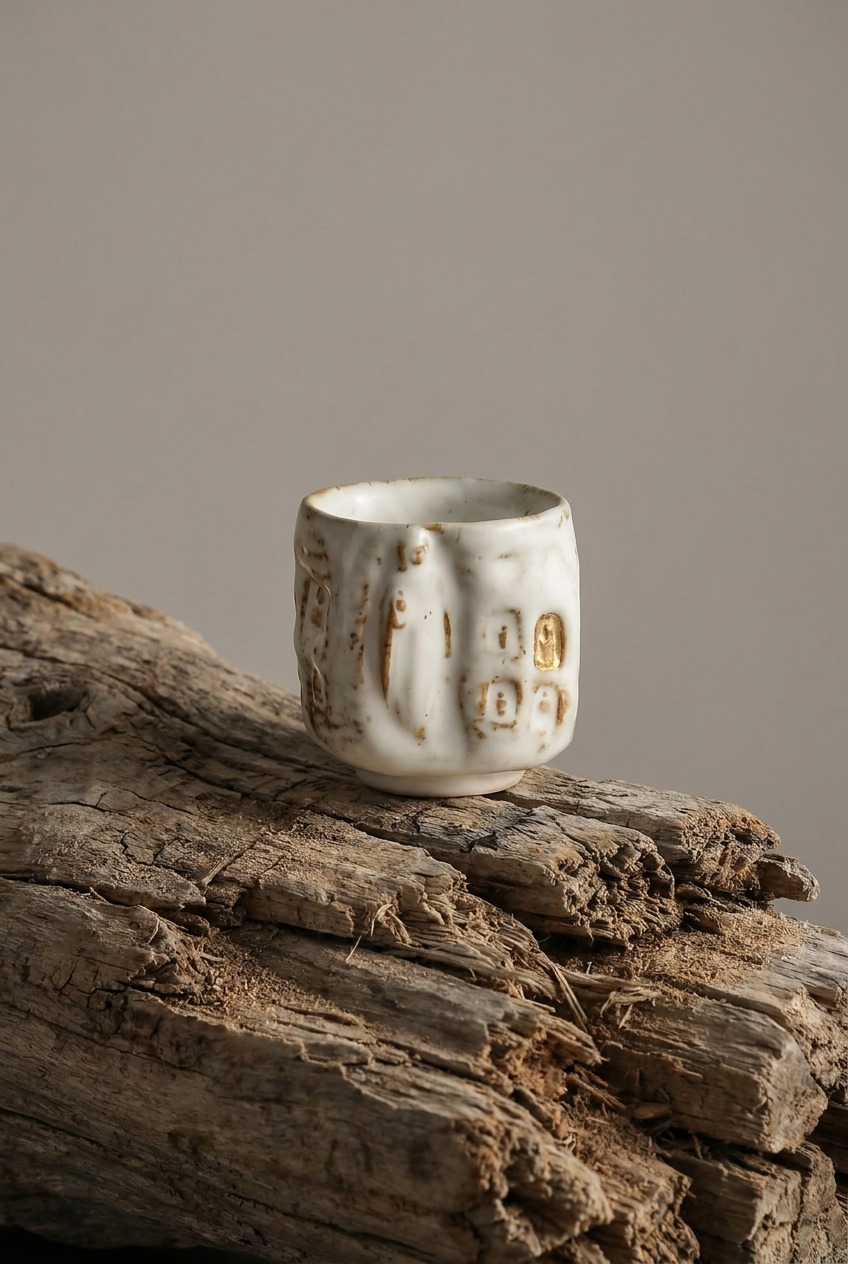
Wood-fired pieces in particular carry surface complexity — the variation in glaze, the marks of the fire, the small irregularities of hand-forming — that gives them a quality of presence that machine-made objects lack. In the context of a feng shui workspace, this matters: feng shui decor is ultimately about objects that have been chosen for a reason, that contribute something specific to the energy of the space. A handmade ceramic piece, placed deliberately on a desk as a focal point and Earth element anchor, does both.
The Resilient Gold — fired in Shino clay, with a gold rim that follows the natural movement of the clay — is a piece that works particularly well in this context. At 5 cm wide and 4 cm tall, it holds a small measure and a specific visual quality: the gold figure on its surface reads as stillness without religiosity, presence without announcement. As spiritual decor for a workspace, it introduces the contemplative without dominating the functional. As an Earth element anchor in a zen home decor approach to office design, it grounds without heaviness. It is a piece worth looking up at.
8. Frequently Asked Questions
Do I need to believe in feng shui for it to work?
No. The most effective feng shui principles — the command position, the clutter-clarity relationship, the use of natural materials and considered focal points — are independently supported by environmental psychology research. You do not need to accept the cosmological framework to benefit from the practical recommendations. The desk placement works because of how the human nervous system responds to its visual environment, not because of any particular belief about energy flow.
Feng shui decor: what are the most important elements to start with?
If you're starting from nothing, in this order:
| Priority |
Action |
| 1 |
Command position — face the door without being directly in line with it |
| 2 |
Clear the visual field — remove everything not in active use or deliberately placed |
| 3 |
Add one Earth element anchor — a ceramic piece, stone, or substantial natural object |
If you are starting from scratch, prioritise three things in order. First, the command position: place your desk so you face the door without being directly in line with it. Second, clear the visual field: remove everything from your desk surface that is not in active use or deliberately placed. Third, introduce one Earth element anchor — a ceramic piece, a stone, a substantial natural object — that gives your eyes somewhere to rest during the pauses in your work. These three changes address the most significant feng shui variables without requiring any additional purchases or significant rearrangement.
How does feng shui relate to minimalist or zen interior design?
Feng shui, minimalist design, and zen home decor share a common concern: the quality of attention that a space supports. All three traditions favour the considered over the accumulated, the purposeful over the decorative, the object that earns its place over the object that fills a gap. The differences are in emphasis — feng shui is more explicitly concerned with energy direction and elemental balance, while minimalist and zen aesthetics focus more on visual restraint and material honesty. In practice, these approaches are highly compatible. A space designed along feng shui principles will often read as minimal and zen, not because those aesthetics were the goal, but because the underlying logic is similar: fewer things, chosen well, placed with intention.
A Final Note
The value of feng shui decor for a home office is not that it guarantees focus or productivity. No arrangement of furniture and objects can do that. Its value is that it removes the small, chronic frictions that accumulate in a poorly arranged space — the discomfort of sitting with your back to the door, the cognitive weight of a cluttered surface, the absence of anything worth looking at during the pauses in your work.
Remove those frictions, and the space does not do the work for you. But it stops working against you. That, in the context of a long working day, is more valuable than it sounds. And according to the latest feng shui thinking for 2026, the direction is toward refinement over addition — fewer objects, clearer sightlines, more deliberate choices. Which is, in the end, simply good design.
References


